Bearing off in backgammon: when you can start and how it works
Bearing off means taking your checkers off the board. You may start only when all 15 checkers are in your home board. A die then bears off a checker from the point with the same number. A higher number bears off your farthest checker when no checker stands higher. The first player to bear off all 15 wins.
Below is each rule with a diagram, and what changes when a checker is hit. The points are numbered from White's side: White's home board is points 1 to 6, and White bears off past the 1-point.
When can you start bearing off in backgammon?
As soon as your last checker reaches your home board, even in the middle of a turn. You don't have to wait for the next roll: one die can bring the last checker home and the other can already bear off.
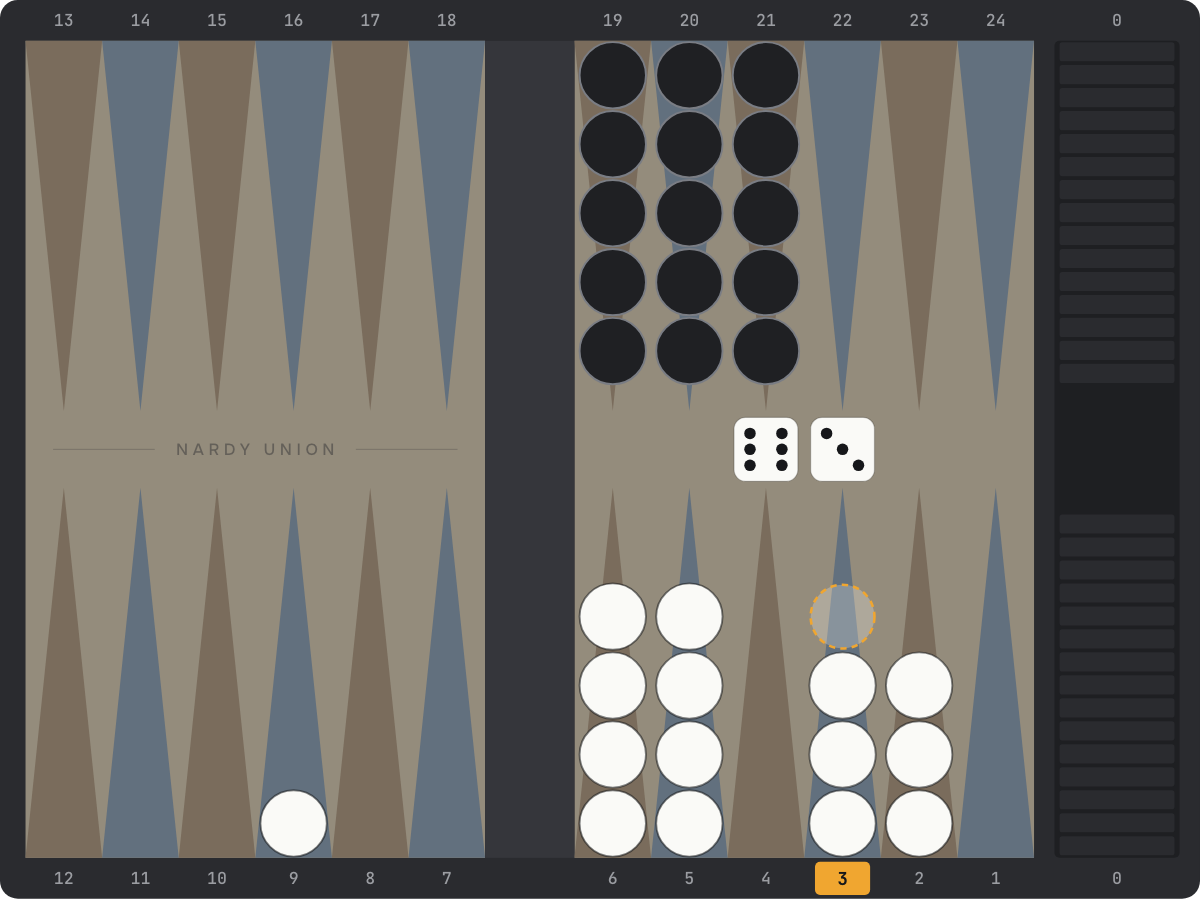
Until then you cannot bear off at all. If 14 checkers are home and one stands on the 7-point, a 6 cannot take a checker off the 6-point. A checker on the bar counts as outside your home board too.
How bearing off works: the number on each die
Each die is used on its own, just as in the rest of the game. With every die you have three cases:
| What stands on the board | What the die does | Example |
|---|---|---|
| A checker on the point with the die's number | Bears that checker off | A 4 bears off from the 4-point |
| That point is empty, a higher point has checkers | Must move a checker inside the home board | A 4 with checkers on the 5- and 3-points: 5/1 |
| That point and all higher points are empty | Bears off the farthest checker | A 6 with the farthest checker on the 3-point: 3/off |
The two dice can also work together on one checker. With a lone checker on the 6-point and a roll of 4-2, you play 6/2 with the 4 and bear it off with the 2.
Do you need the exact number to bear off?
No. A higher number bears off your farthest checker as long as nothing stands on a higher point. With two checkers left, on the 3- and 2-points, a roll of 6-5 takes both off.
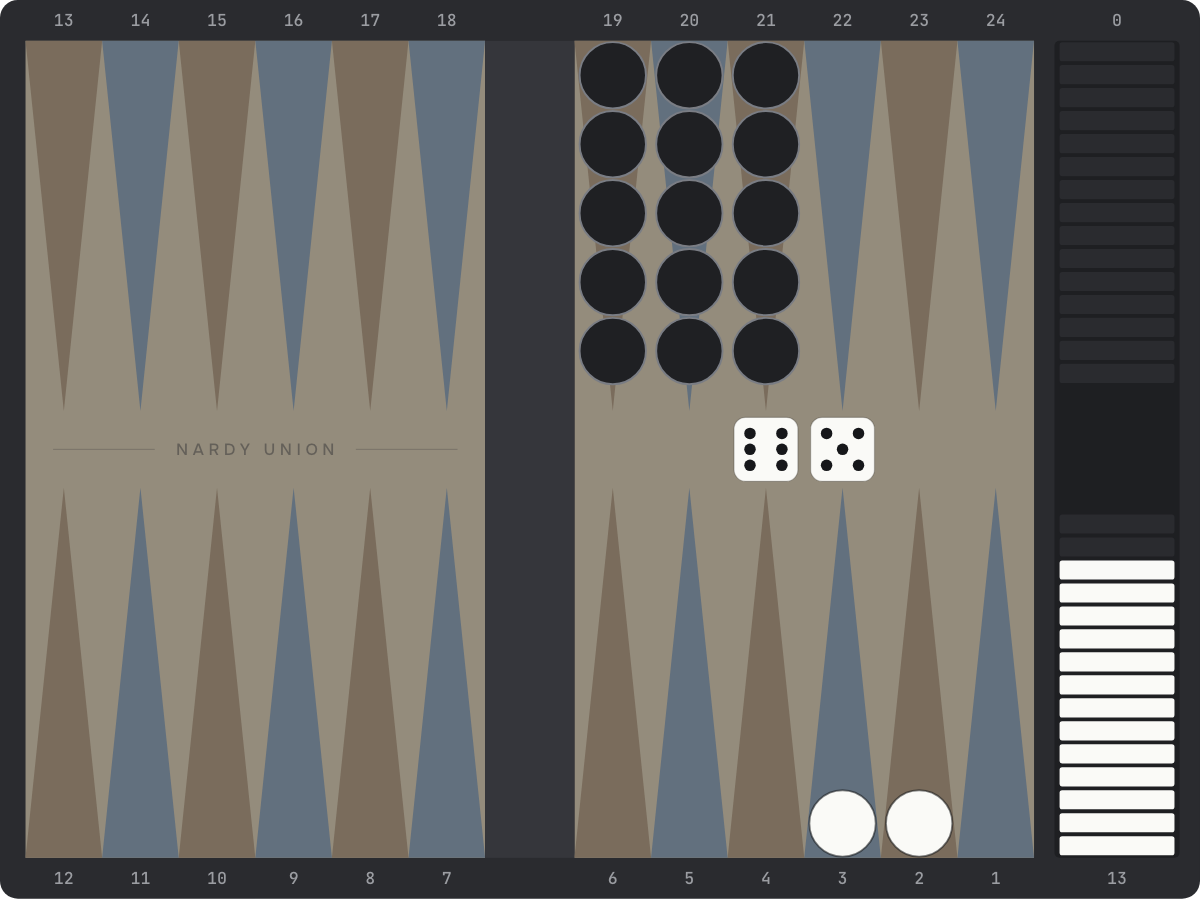
A higher number cannot skip over a checker that is farther away. With checkers on the 5- and 3-points, a 4 cannot bear off from the 3-point. It has to move the checker on the 5-point. The order of the dice matters here: with 4-2, play the 2 first, 5/3, and the 4 then bears off from the 3-point. Played the other way, 5/1 and 3/1, nothing comes off.
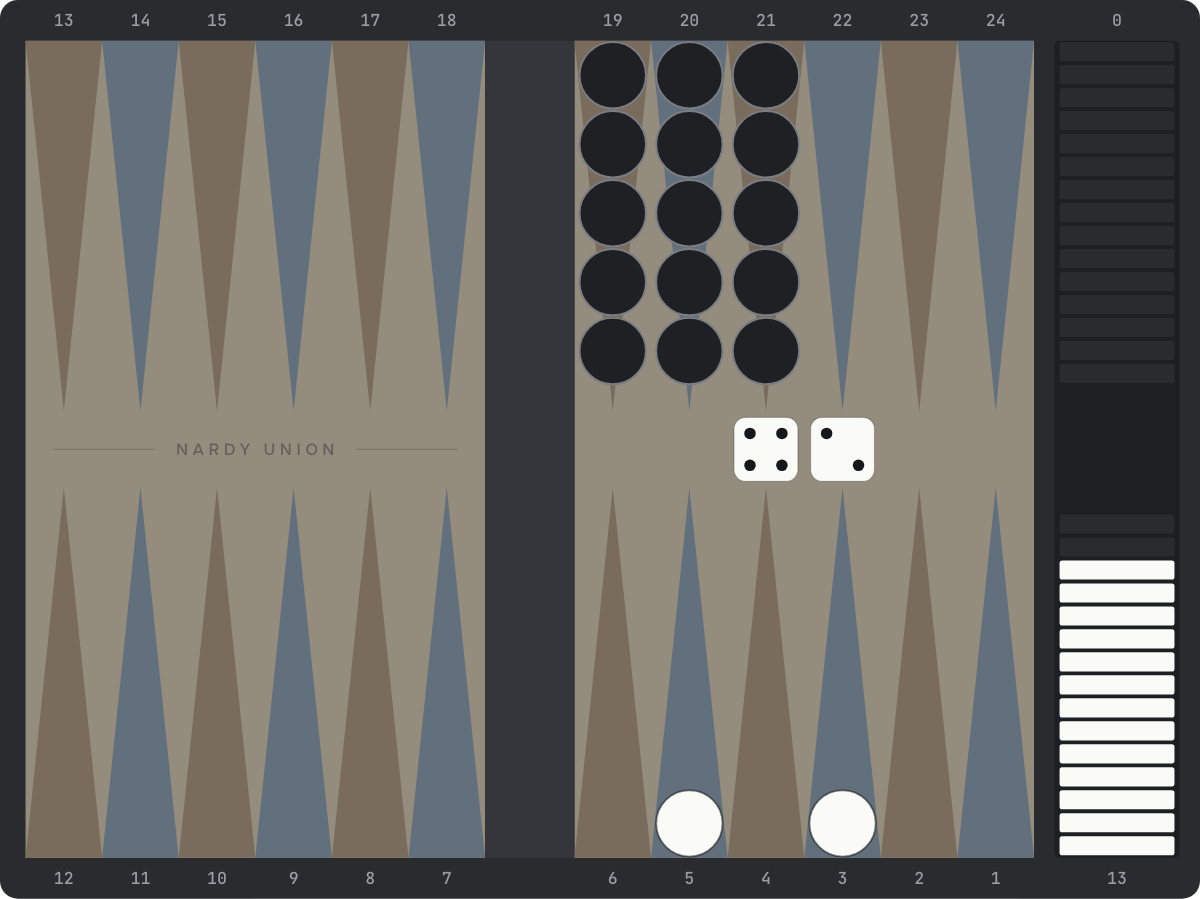
Do you have to bear off?
No. Instead of bearing off you may make an ordinary move inside your home board, for example 6/1 with a 5. The usual rule still holds: if both dice can be played, you must play both, and if only one can, you play the larger. With 5-3 and checkers on the 6-, 5-, 4- and 3-points, you can bear off two checkers (5/off and 3/off), one, or none (6/1 and 6/3). Why you would ever choose fewer: to avoid leaving a lone checker while your opponent still has checkers in your home board.
Rolling doubles when bearing off
Doubles are played four times, as always, and each of the four moves follows the same rules. With 5-5 and three checkers left, on the 4-, 2- and 1-points, the first 5 bears off the checker on the 4-point, the next the one on the 2-point, the third the one on the 1-point. The game is over; the fourth 5 is not needed.
What happens if a checker is hit during the bear-off?
Your opponent may still have checkers in your home board, and if you leave a lone checker (a blot) there, it can be hit. The hit checker goes on the bar, and bearing off stops. You must bring it back in through your opponent's home board and move it all the way round to your own home board before you bear off again. Checkers you have already borne off stay off.
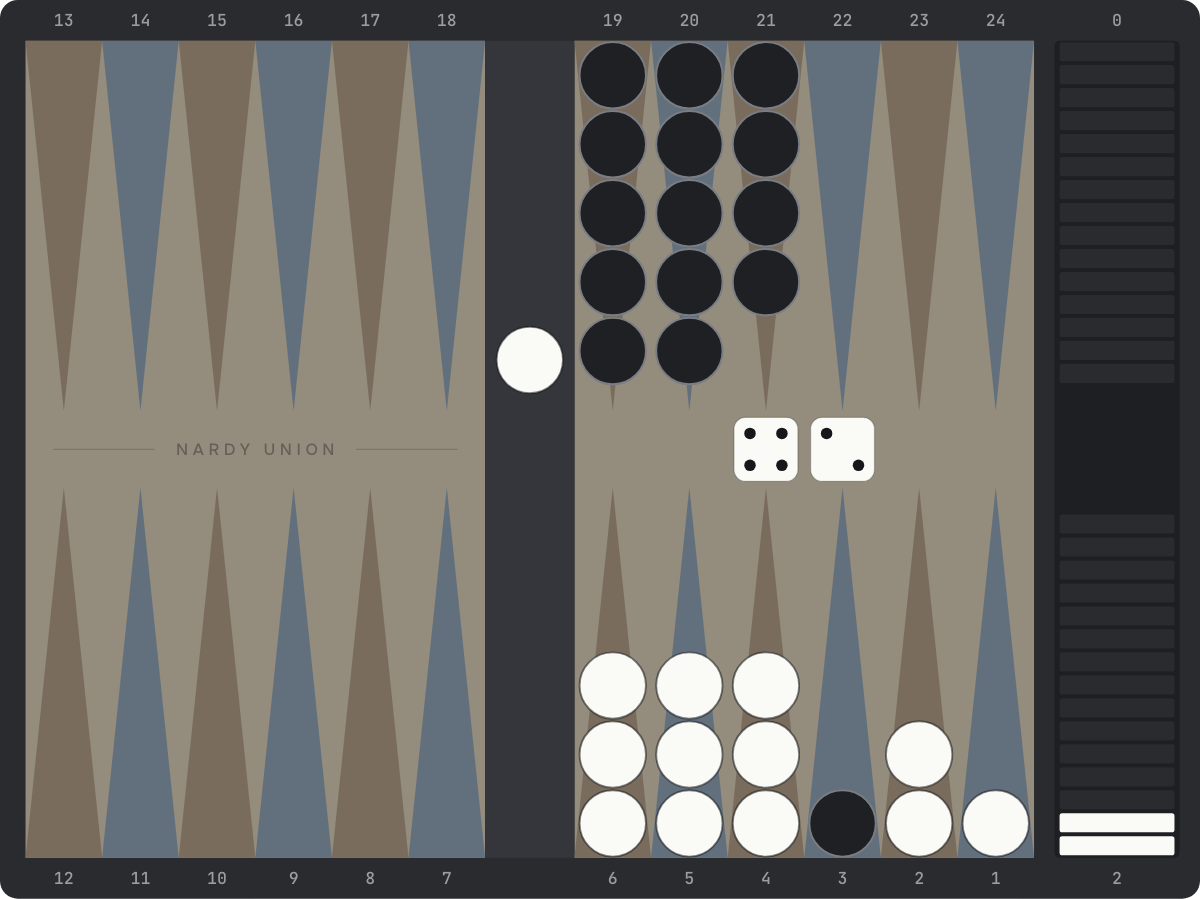
In the diagram White has to play the 4 inside the home board, 6/2 or 5/1: the checker on the 23-point is outside, so nothing can come off. A hit like this often turns a won race into a lost game. It can also cost more than the game. If your opponent bears off all 15 before you bear off a single checker, you lose a gammon, worth 2 points, and a backgammon, worth 3, if you still have a checker on the bar or in their home board. Details are on the gammon and backgammon page.
Odds of bearing off your last checkers in one roll
At the end of a race the question is whether your next roll finishes the game. These counts come from going through all 36 rolls under the rules above.
| Last checker on the | Rolls that bear it off |
|---|---|
| 1-, 2- or 3-point | 36 of 36 |
| 4-point | 34 of 36 |
| 5-point | 31 of 36 |
| 6-point | 27 of 36 |
| Last two checkers on the | Rolls that bear off both |
|---|---|
| 2- and 1-points | 36 of 36 |
| 3- and 1-points | 34 of 36 |
| 2-point (both) | 26 of 36 |
| 4- and 1-points | 29 of 36 |
| 3- and 2-points | 25 of 36 |
| 3-point (both) | 17 of 36 |
| 5- and 1-points | 23 of 36 |
| 6- and 1-points | 15 of 36 |
| 4-point (both) | 11 of 36 |
| 6- and 5-points | 6 of 36 |
| 6-point (both) | 4 of 36 |
Two checkers on the 6-point come off only with a double of 3 or more: 3-3, 4-4, 5-5 or 6-6. Two checkers on the 2-point miss with the 10 rolls that have a single 1, such as 4-1: the 4 bears off one checker and the 1 only moves the other to the 1-point. On the 2- and 1-points every roll finishes.
Bearing off in long nardy
In long nardy the dice work the same way: you start when all 15 are home, a die bears off from its point, and a higher die takes the farthest checker. What differs is the rest. There is no hitting, so a bear-off is never interrupted and no checker ever goes back. There is no backgammon: if the loser has borne off nothing, it is a mars, worth 2 points. And as in short backgammon, the game ends the moment someone bears off the last checker, with no extra roll.
The full rules of short backgammon, from the setup to the doubling cube, are in backgammon rules, and a summary of both games is on the rules page. The quickest way to learn bearing off is to play: the board only lets you make legal moves. Start a game of backgammon online with the button below.