Backgammon rules: setup, hitting and bearing off
In backgammon each player has 15 checkers. The players move towards each other, and a lone checker can be hit. The first player to bear off all their checkers wins. A single game is worth 1 point, a gammon 2 and a backgammon 3. Every rule is below, with a diagram.
On this site the game is called short backgammon, to set it apart from long nardy.
The points on the diagrams are numbered from White's side. White moves from the 24-point to the 1-point, and White's home board is points 1 to 6. Black moves the other way, and Black's home board is points 19 to 24 (for Black these are also points 1 to 6, seen from the other side).
How to set up a backgammon board
Each player has 2 checkers on the 24-point, 5 on the 13-point, 3 on the 8-point and 5 on the 6-point. Black's setup mirrors White's. The checkers on the 24-point are the farthest from home; those on the 6-point are already in it. At the start both players have a pip count of 167, the total distance all their checkers must travel to bear off.
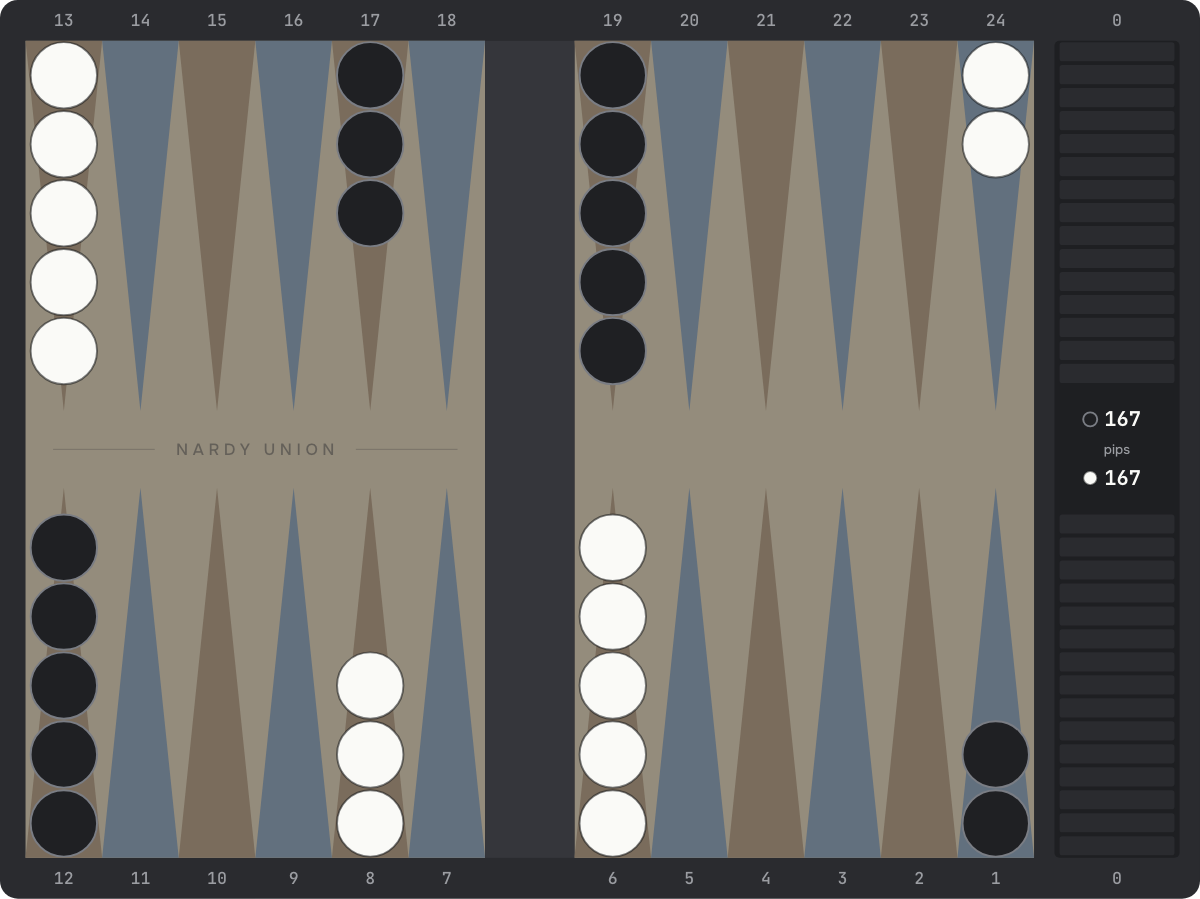
You don't need to memorise it: in a game against the computer the site sets up the board for you.
That makes 15 checkers per player and 30 on the board. What else is in a set, and how many pieces can share one point, is in how many pieces in backgammon.
Who goes first
Each player rolls one die. The higher number goes first and plays both numbers rolled, with no new roll. If the numbers are equal, both roll again. A tie on this roll comes up 6 times in 36, on average once every six games.
How the checkers move
Each die is a separate move. With 5-3 you can move one checker 5 and another 3, or one checker 8 if it can stop on the point in between. Checkers move forward only, towards your home board. If both dice can be played, you must play both. If only one can be played, you play the larger one. If neither can be played, the turn passes to your opponent.
Doubles are played four times: with 4-4 you have four moves of four.
What a closed point means
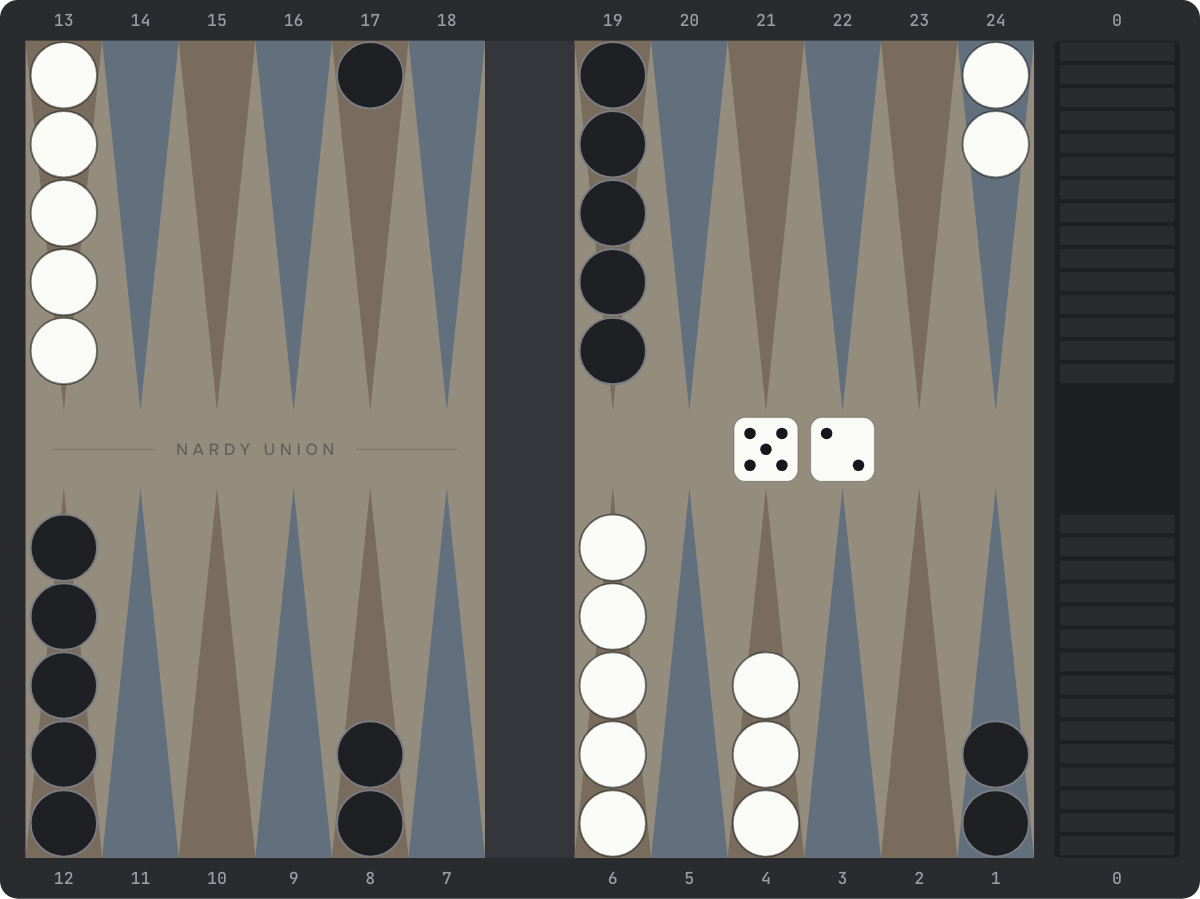
A point is closed when two or more opposing checkers stand on it. You cannot land on a closed point, but you can jump over it. You can always land on a point that holds your own checkers or none, however many are there.
How hitting works and what the bar is
A single opposing checker, a blot, does not close a point. If you land on it, it is hit: it comes off the board and goes on the bar, in the middle. In the move notation a hit is marked with an asterisk: 13/8*.
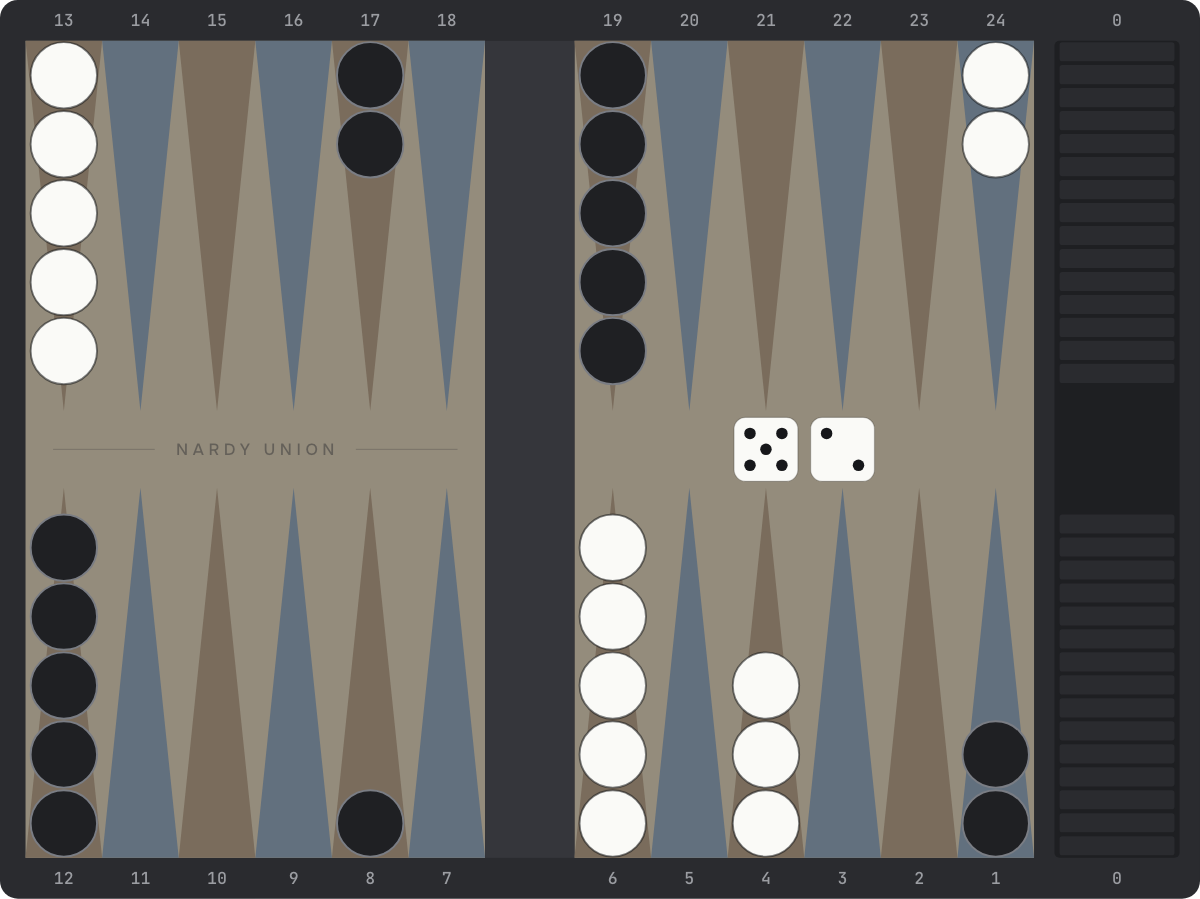
The player who was hit must bring the checker back in first; while it is on the bar, no other checker may move. It enters in the opponent's home board: a die of N puts it on point 25 − N, so a 1 enters on the 24-point and a 6 on the 19-point. If that point is closed, the die cannot be used. If all six entry points are closed, the whole turn is lost.
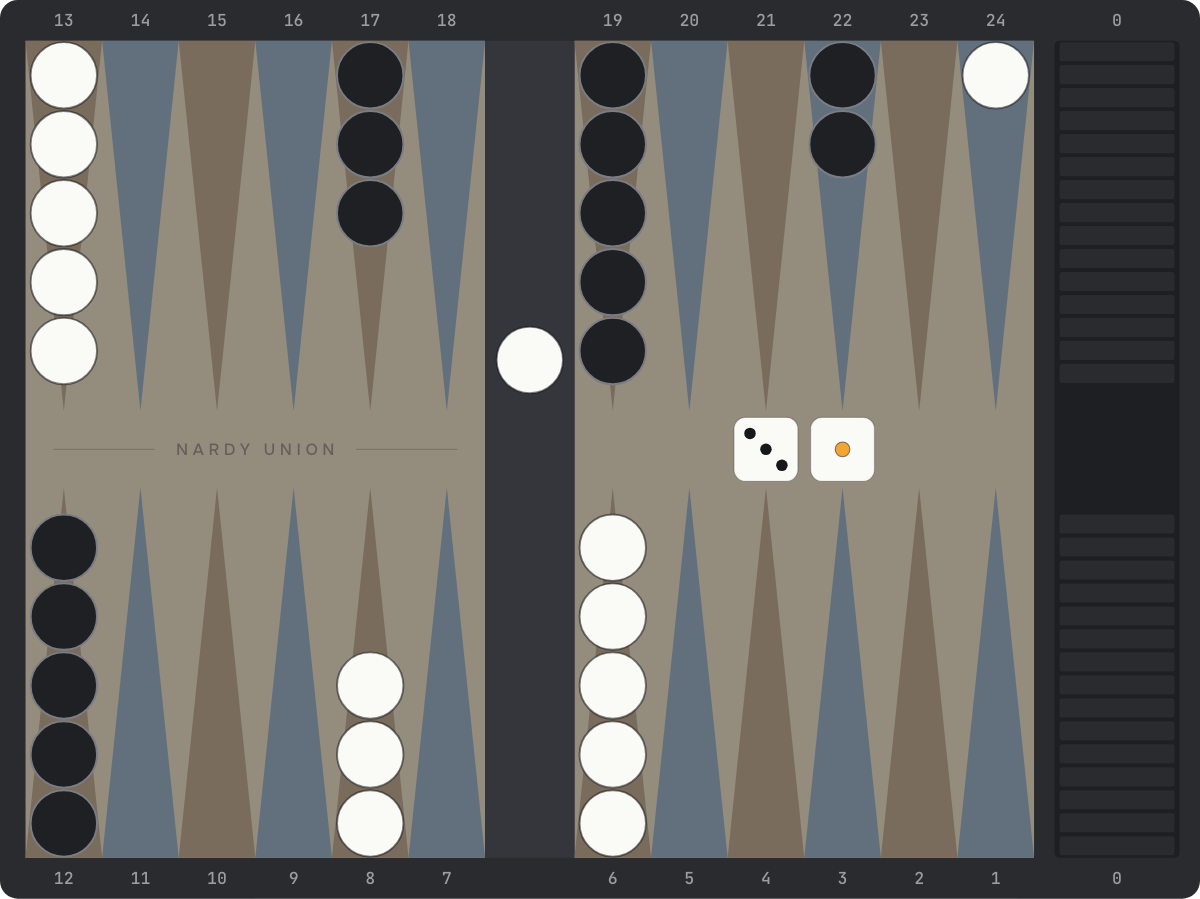
The more points are closed in your opponent's home board, the harder it is to come in. How many of the 36 rolls let a checker enter (counted by going through every roll):
| Closed points in the opponent's home board | Rolls that let the checker enter |
|---|---|
| 0 | 36 of 36 |
| 1 | 35 of 36 |
| 2 | 32 of 36 |
| 3 | 27 of 36 |
| 4 | 20 of 36 |
| 5 | 11 of 36 |
| 6 | 0 of 36 |
Bearing off rules
You may bear off only when all 15 checkers are in your home board. If even one is still on its way, you cannot bear off. That includes a checker that was hit: until it is back home, bearing off waits.
- A die bears off a checker from the point with the same number: a 4 from the 4-point.
- If that point is empty but higher points hold checkers, you must move inside your home board with that die.
- If that point and every higher point are empty, the die bears off your farthest checker.
- Instead of bearing off, you may make an ordinary move inside your home board.
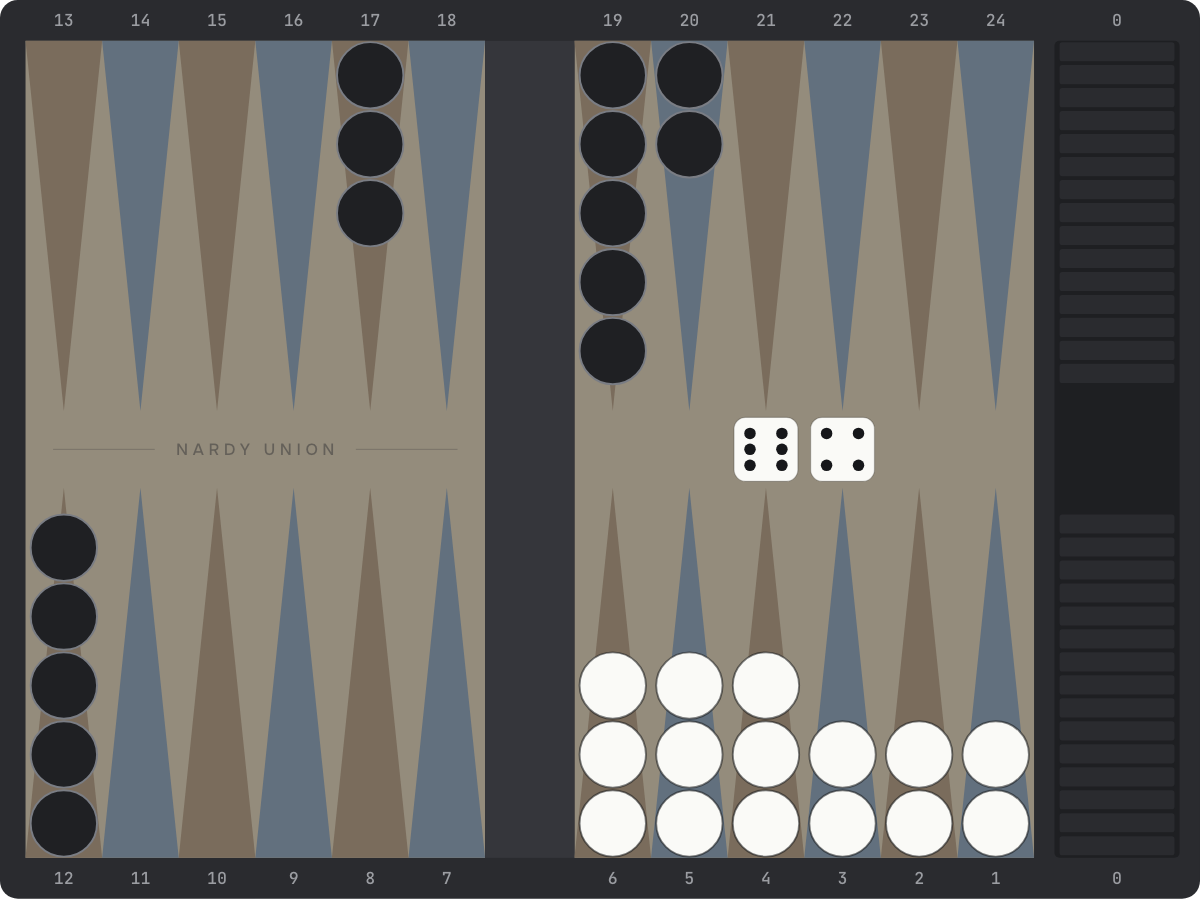
An example. You have just two checkers, on the 3-point and the 2-point, and you roll 6-5. The 6 bears off the checker on the 3-point, the farthest one, and the 5 bears off the one on the 2-point.
Doubles, a checker hit during the bear-off and the odds of finishing in one roll are on the bearing off in backgammon page.
Backgammon scoring: who wins and how many points
The first player to bear off all 15 checkers wins.
| Result | When | Points |
|---|---|---|
| Single game | The loser has borne off at least one checker | 1 |
| Gammon | The loser has borne off no checkers | 2 |
| Backgammon | The loser has borne off no checkers and still has one on the bar or in your home board | 3 |
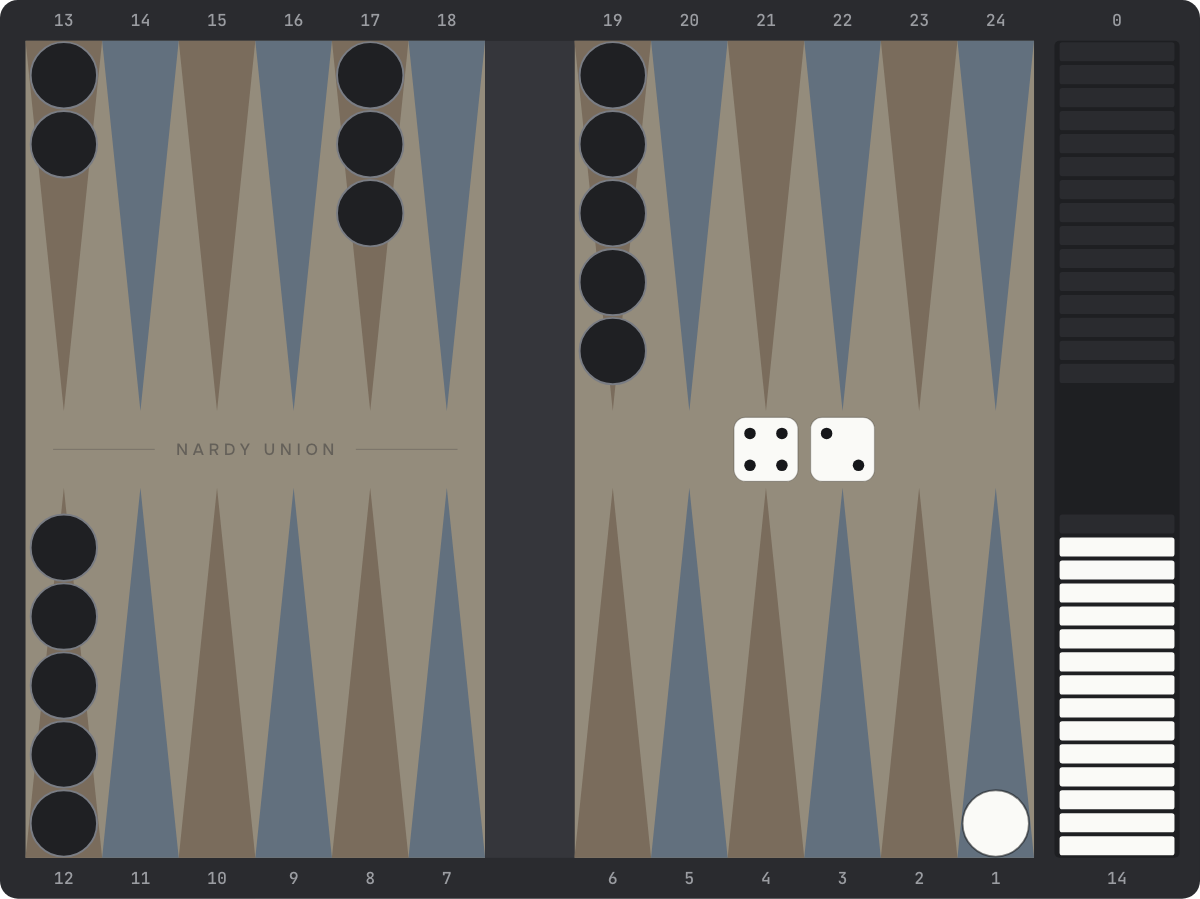
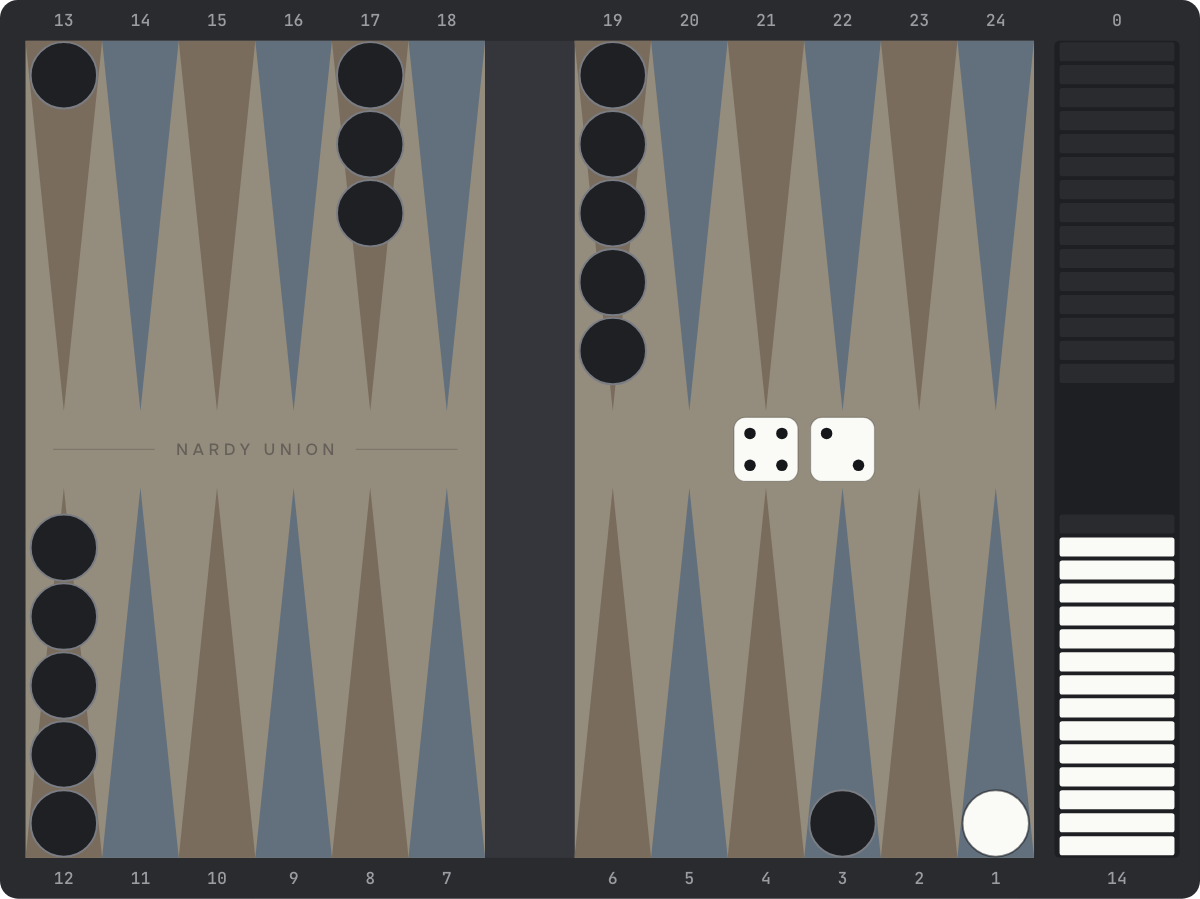
More on scoring, with the cube, is on the gammon and backgammon page.
There are no draws in backgammon, just as in long nardy: whoever bears off every checker first wins.
How the doubling cube works
In backgammon the game is played for the number the cube shows. It starts in the middle, at 1. Before your roll you may double the stakes. Your opponent either takes: the cube moves to their side and shows 2, and later they may redouble. Or they pass: then you win 1 point at once. You cannot double after rolling, and you cannot double while the cube is on your opponent's side. The cube goes up to 64.
In matches the first game after a player gets within one point of winning is the Crawford game, played without the cube. Long nardy has no doubling cube at all. When to double and when to take, with the maths, is on the backgammon doubling cube page.
How backgammon differs from long nardy
In short backgammon the checkers are spread over the board, the players move towards each other, there is hitting, a bar and a cube, and a game can end in a backgammon worth 3. In long nardy every checker starts on the head, there is no hitting, and instead you may not build a block of six points in a row. A side-by-side summary is on the rules page.
If you are completely new, start with how to play long nardy: it walks through a first game move by move. The rules are easiest to learn by playing, since the board won't allow an illegal move. Start backgammon online with the button below.