How the backgammon doubling cube works
The doubling cube is a die marked 2, 4, 8, 16, 32 and 64. It shows how many points a game of backgammon is worth. It starts in the middle, worth 1. Before your roll you may double: your opponent either takes and plays on for 2 points, or passes and loses 1. Long nardy here has no cube.
Below: how doubling works step by step, when to double and when to take, what the cube does in a match, and how our bot plays it. Checkers and point numbers in the diagrams are seen from White's side.
What is the doubling cube in backgammon?
Without the cube a game of backgammon is worth one point, a gammon two and a backgammon three. The cube lets the stakes go up during the game. The player who thinks they are winning offers to double. The player who is behind chooses: give up one point now, or play on for two and risk losing more.
So the cube ends hopeless games early and turns a better position into points.
The cube has no face with a 1. Until someone doubles, it sits in the middle with 64 on top: that is the usual way to show the cube is still nobody's and worth 1. The site draws it the same way.
How does the doubling cube work?
- You may double only before your own roll. Once you have rolled, the button is gone until your next turn.
- While the cube is in the middle, either player may double. After a double is taken, the cube goes to the player who took it, and only they may double next. A double by the cube's owner is called a redouble.
- Your opponent takes or passes. A take doubles the stakes, and the cube is on their side. A pass ends the game: they lose what the cube was worth before the double.
- The result of the game is multiplied by the cube: a single game 1, a gammon 2, a backgammon 3 points. A gammon with the cube on 4 is 8 points.
- The cube does not go above 64.
| Cube before the double | A pass costs | After a take the game is worth |
|---|---|---|
| 1 (in the middle) | 1 point | 2 points |
| 2 | 2 points | 4 points |
| 4 | 4 points | 8 points |
| 8 | 8 points | 16 points |
| 16 | 16 points | 32 points |
| 32 | 32 points | 64 points |
On the site a Double button sits next to Roll before your roll. Your opponent gets a window with Take and Pass. A taken double is written into the move list. If you have Auto-roll on, the game will not roll for you while you may double and the bot puts your chances at 65% or more: the decision stays yours.
When should you double in backgammon?
Double when you are clearly ahead but your opponent can still take. Too early, and you hand over the cube in a nearly even game, so only your opponent can double from then on. Too late, and your opponent passes: you get one point where you could have won two, or four with a gammon.
Our bot doubles when it puts its own chances of winning at 70% or more. The estimate is rough, from the pip count and the position. It is the bot's rule, not an exact answer: a strong player could decide differently in the same position.
A double is strongest when one roll can decide the game. In the diagram a black checker is on the bar and White has closed five home points. Black can come in only with a 1, which is 11 rolls out of 36.
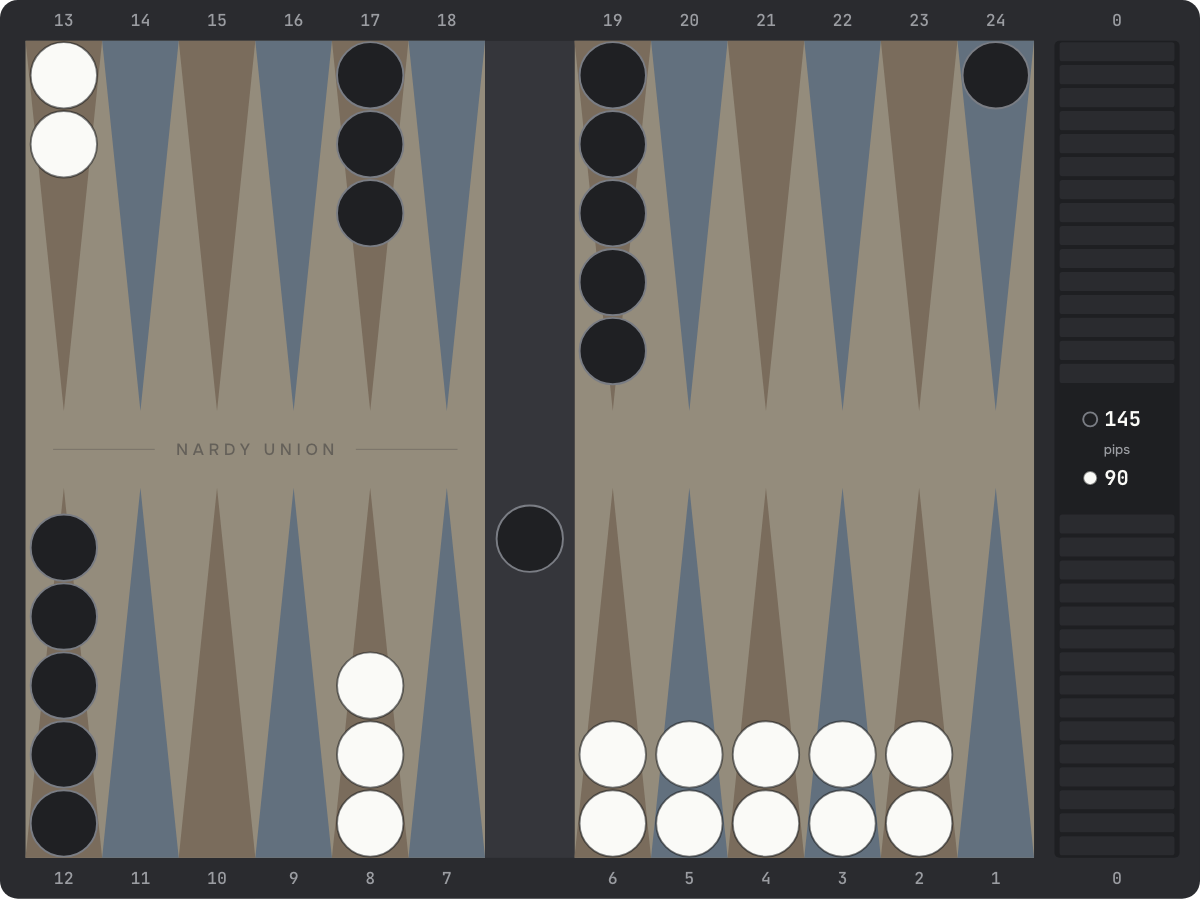
Without a double the game goes on for one point, and one good roll brings Black back into it. The double makes your opponent pay for that point now.
When should you take a double, and when should you pass?
With the cube in the middle a pass costs exactly one point. A take means playing for two: win and you get 2, lose and you give 2. If your chance of winning is p, a take is worth 2p − 2(1 − p) = 4p − 2 points on average. That equals minus one exactly at p = 25%. Hence the quarter rule: take if you win at least one such game in four.
| Your chance of winning | Pass | Take, on average | Better choice |
|---|---|---|---|
| 10% | −1 | −1.6 | pass |
| 20% | −1 | −1.2 | pass |
| 25% | −1 | −1 | the same |
| 30% | −1 | −0.8 | take |
| 40% | −1 | −0.4 | take |
| 50% | −1 | 0 | take |
This holds for games without gammons. If you may lose a gammon, a take can cost 4 points (2 × 2), and a quarter is not enough: you need more. On the taker's side is the cube itself: if the game turns, only the taker can double again.
Our bot takes when it puts its chances at 25% or more. The two races below differ only in how far Black is behind.
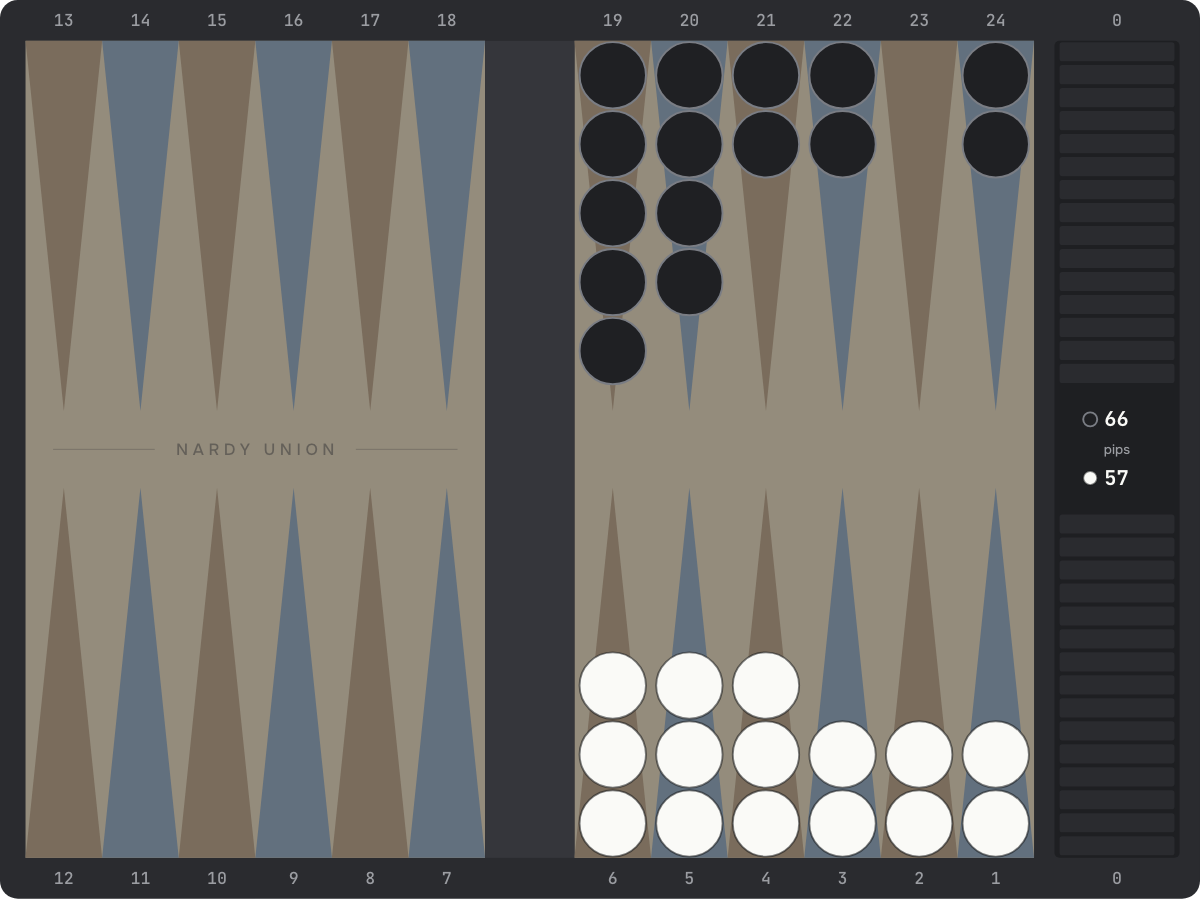
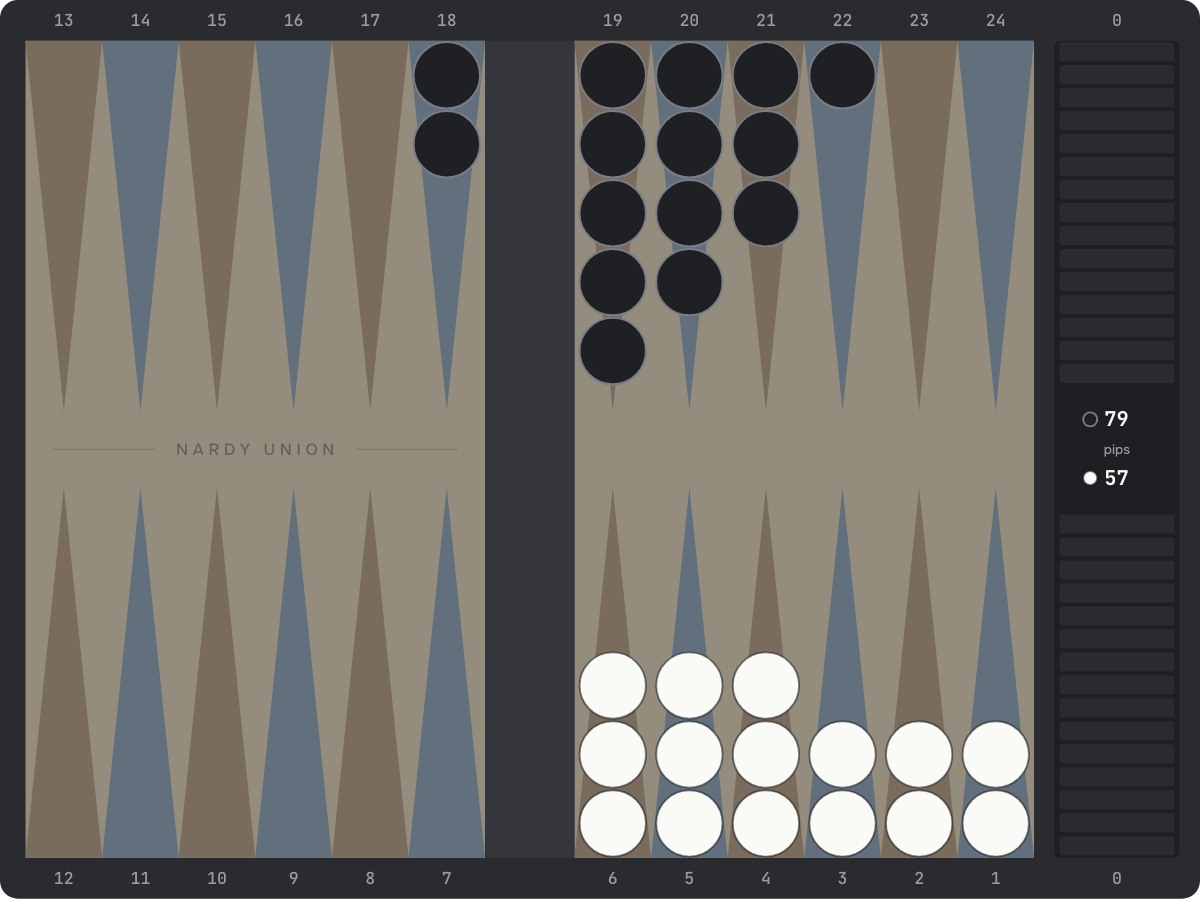
In a race, once there is no contact, the count is simplest: compare pip counts. The end of a race, when checkers come off, is on the bearing off in backgammon page.
How our bot uses the cube: 1,000 games
We played 1,000 games of each bot against itself on the site's engine, with the cube, for Medium Bot and Hard Bot. Their cube rules are the same: double at 70%, take at 25% by their own estimate. Only their checker play differs.
| Per 1,000 games | Medium Bot | Hard Bot |
|---|---|---|
| Games where someone doubled | 998 | 996 |
| Doubles taken | 941 | 937 |
| Doubles passed | 350 | 315 |
| Games with a redouble | 259 | 234 |
| Taker went on to win the game | 30% of takes | 28% of takes |
| First double, median | turn 16 | turn 16 |
| Games that ended with the cube on 4 or higher | 147 | 149 |
| Average points per game | 2.65 | 2.54 |
Two things stand out. The cube comes into play in almost every game, and roughly one game in three ends with a pass rather than a bear-off. And a taker at "a quarter or better" wins about 30% of those games: the bot's quarter rule matches the results. The cube went above 8 only once in the 2,000 games, in a Medium Bot game.
The doubling cube in match play: the Crawford rule
In a match to several points the cube works the same, with two exceptions. A 1-point match has no cube at all: there is nothing to double. And when one player first gets within one point of winning, the next game is played without doubles. That is the Crawford game, and the site labels it so.
Example: a 5-point match at 4–2. The next game is the Crawford game, and nobody has a Double button. If the trailing player wins it and the score becomes 4–3, the cube comes back. The leader needs only one point anyway, so a double usually costs the trailer nothing, and they double at once.
Is there a doubling cube in long nardy?
Not on this site: long nardy here is played without a cube, a game is worth 1 point and a mars 2. How long nardy scores is on the gammon and backgammon page.
Jacoby rule, beavers and automatic doubles
Some players add house rules. The Jacoby rule: gammons and backgammons count only if the cube has been turned. A beaver: the player who takes a double may at once double again and keep the cube. Automatic doubles: when the opening roll is a tie, the cube goes to 2. The site has none of these. Gammons and backgammons always count, and the cube goes up only in turn and only when a player chooses to double.
Where to try the doubling cube
Open backgammon online against the bot: before your roll you will have a Double button, and the bot will double you too. The full rules are in backgammon rules and on the rules page. What earns two and three points is explained in gammon and backgammon.