How many pieces in backgammon: checkers, board and dice
Each player has 15 checkers (pieces) of their own colour, so a game uses 30: 15 white and 15 black. A full set also has a board with 24 points, two dice and a doubling cube. Two people play. The counts are the same in backgammon and in long nardy; only the starting position differs.
How many pieces does each player have in backgammon
Fifteen, in both games on this site. One player has the white checkers, the other the black.
| Backgammon | Long nardy | |
|---|---|---|
| Checkers per player | 15 | 15 |
| Checkers on the board in all | 30 | 30 |
| Points on the board | 24 | 24 |
| Points taken at the start | 8 (four per player) | 2 (one per player) |
| Pip count at the start | 167 | 360 |
| Dice for moving | 2 | 2 |
| Doubling cube on this site | yes | no |
A checker never leaves the game until it is borne off. The winner is the first player to bear off all 15, so a set with a checker missing can't be played by the rules.
Backgammon setup: how many checkers do you start with, and where
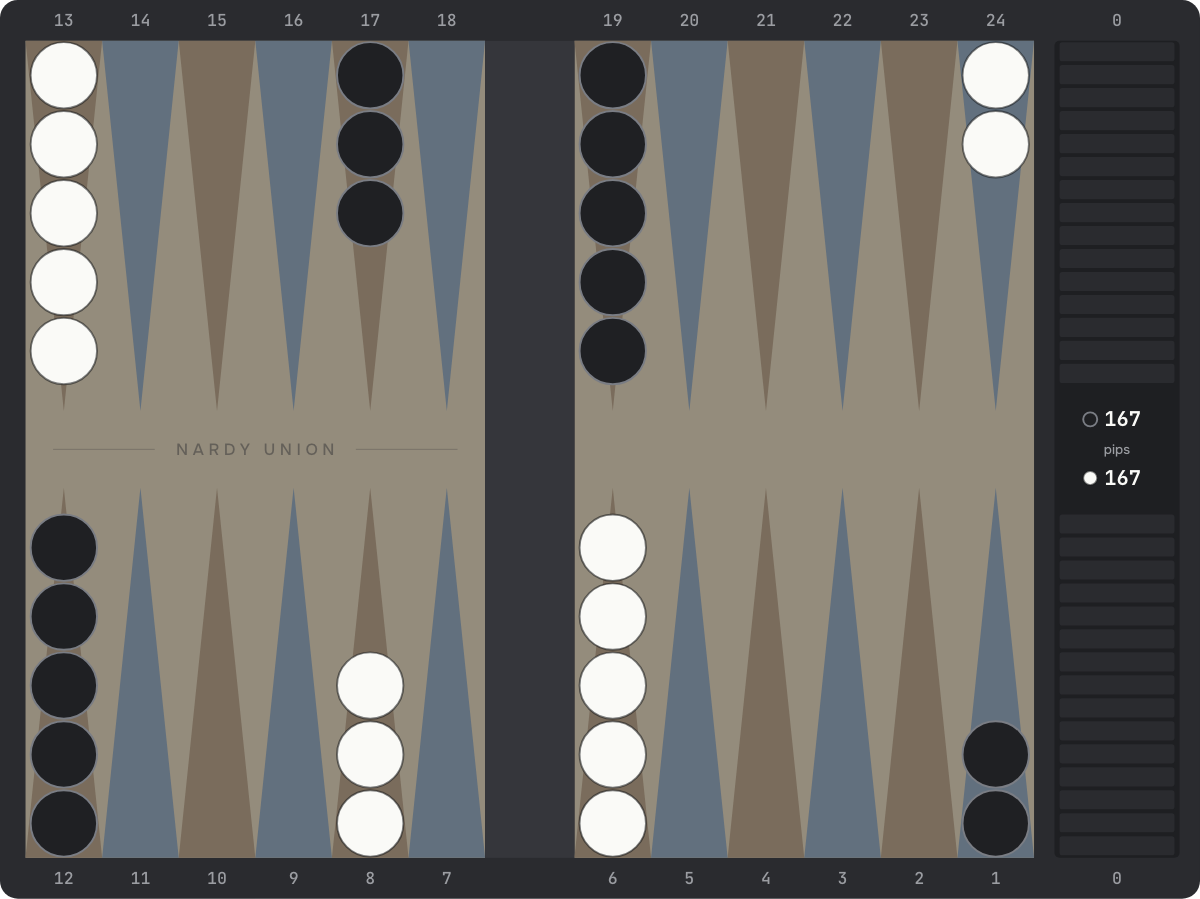
All 15, already on the board. In backgammon they are spread over four points: 2 on your 24-point, 5 on your 13-point, 3 on your 8-point and 5 on your 6-point.
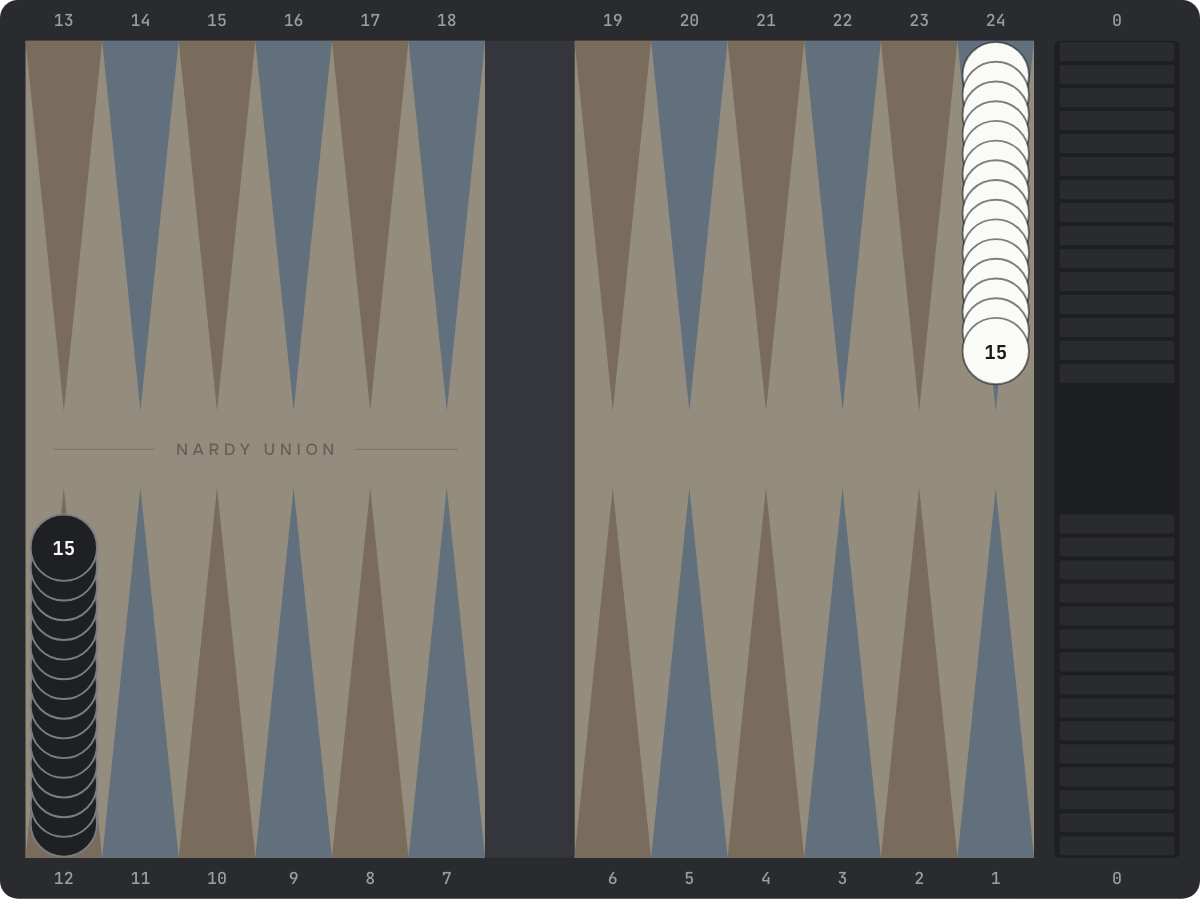
In long nardy all 15 start on one point, the head: White's 24-point and Black's 12-point. The full setup and first moves are in the backgammon rules; how the long game differs, point by point, is in nardy vs backgammon.
How many pieces in a backgammon set
| Item | How many | What it is for |
|---|---|---|
| Checkers | 30 (15 of each colour) | the pieces you move |
| Board | 1, with 24 points | the track the checkers travel |
| Dice | 2 per player, or 2 shared | each turn's move |
| Doubling cube | 1 | raising the stake in backgammon |
So a full set should have 30 checkers, two or four dice and one cube. Many sets come with two pairs of dice and two dice cups, so each player rolls their own; the game needs only two dice at a time. The same 30 checkers and board work for long nardy; it just doesn't use the cube.
How many points on a backgammon board
Twenty-four: the long triangles, twelve on each side. They are numbered 1 to 24 from each player's own side, so your 24-point is your opponent's 1-point. You move from high numbers to low and bear off from points 1–6. Point numbers on our diagrams are from White's side.
| Part | What it is | On the diagram |
|---|---|---|
| Points | the 24 triangles where checkers stand | numbers 1 to 24 on the edges |
| Quarters | four groups of six points | points 1–6, 7–12, 13–18, 19–24 |
| Home board | the last quarter on your way, where you bear off from | points 1–6 for White |
| Bar | the strip down the middle | the dark strip between the 6- and 7-points |
| Tray | where borne-off checkers go; the number shows how many are off | right of the board |
How many checkers can you have on a point in backgammon
As many as you like. There is no limit of five: the long nardy start above has all 15 on a single point. Some old home rule sheets cap a point at five, but the standard rules don't, and neither does this site. Five or more on one point is usually wasteful play, not a broken rule.
What a point does limit is your opponent. In backgammon two or more of your checkers make a point they can't land on. In long nardy one checker is enough.
What happens to a piece that is hit
In backgammon you hit a lone enemy checker by landing on it. It goes to the bar, and its owner must bring it back in before moving anything else. It is not out of the game: the player still has 15 checkers.
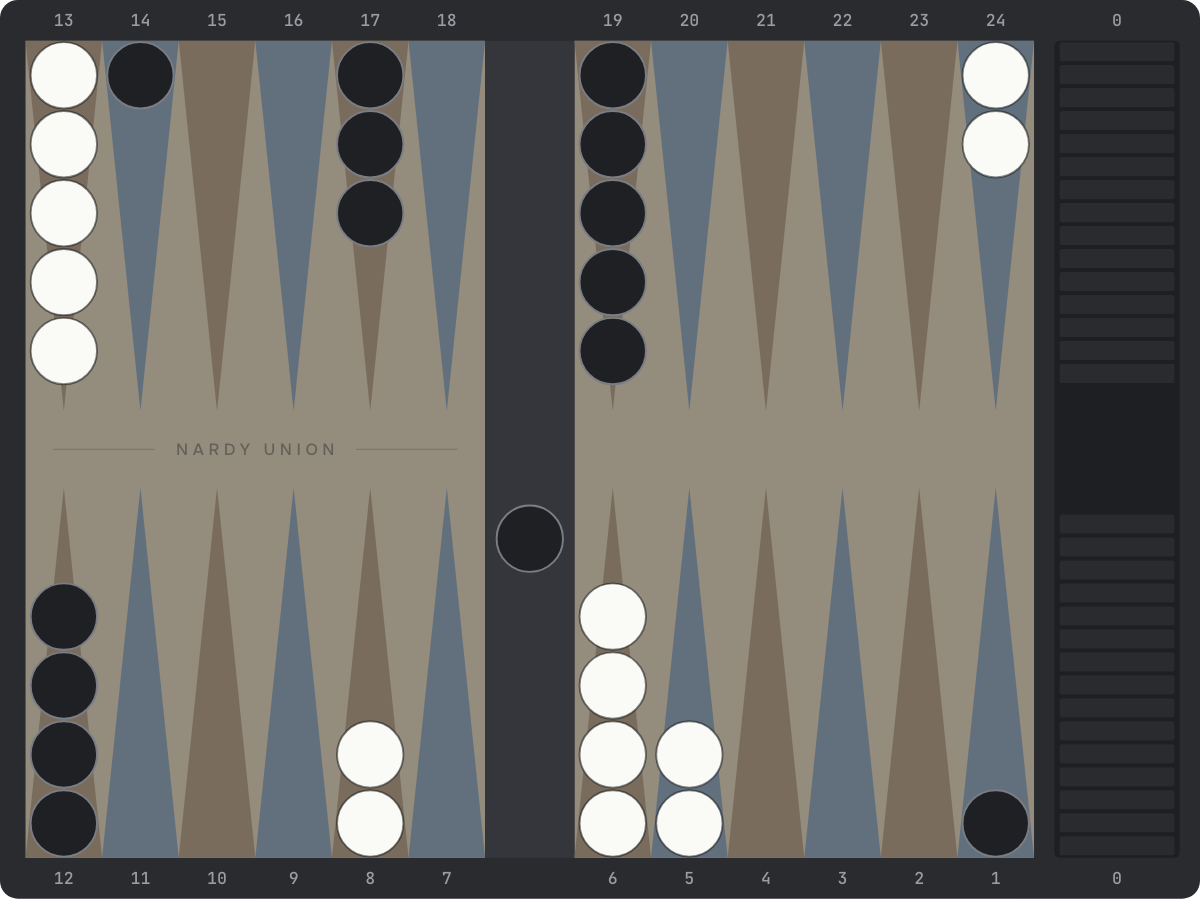
Long nardy has no hitting, so there the bar only divides the board.
Where the checkers go at the end
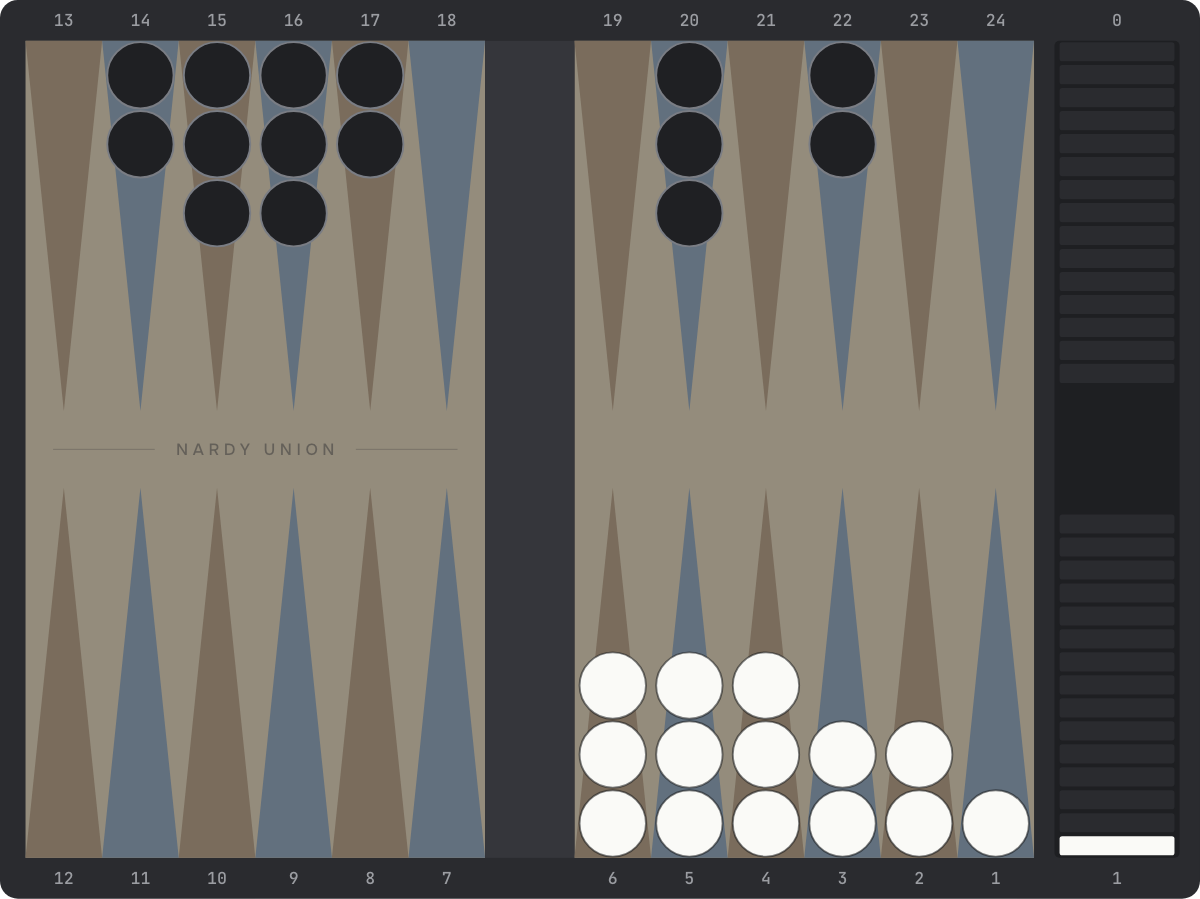
Once all 15 of your checkers are in your home board, you start bearing them off. The first player to bear off all 15 wins. Which die takes which checker off is in bearing off in backgammon.
How many dice in backgammon
Two ordinary dice with faces 1 to 6. Two dice give 36 rolls, 6 of them doubles. If you don't care which die shows which number, there are 21 different rolls. A double is played four times.
Do you have to use both dice? Yes, when you can. One checker may use both numbers in turn if the point in between is open, or two checkers take one number each. If only one number can be played, you play the larger one if it fits.
What is the other dice in backgammon: the doubling cube
The die with numbers 2, 4, 8, 16, 32 and 64 is the doubling cube. It isn't rolled. Before rolling, a player may offer to double the stake. The opponent either accepts and plays on for twice as much or gives up the game. On this site backgammon has the cube, up to 64. Long nardy is played without it.
How many points is a backgammon worth
A plain win is 1 point. A gammon, when the loser has borne off nothing, is 2. A backgammon, when the loser also has a checker on the bar or in the winner's home board, is 3. The cube multiplies the result. In long nardy the double win is called a mars, and there is no triple. How each result is counted is in gammon and backgammon.
A match is played to a set number of points, 5 for example: the first player to reach it wins. A game against the computer here is one game, scored by the table there.
How many players in backgammon
Two, each with their own 15 checkers. Here you can play the computer, a friend by link or an opponent online. All the rules of both games are on the rules page.