Nardy vs backgammon: how the two games differ
Nardy is the Russian word for the backgammon family. When Russian speakers say nardy, they usually mean long nardy: all 15 checkers start on one point, both players move the same way round the board, and nobody is hit. Backgammon is short nardy to them: checkers spread out, players moving towards each other, a lone checker can be hit.
Below is every rule that differs, in one table, the length of a game in both variants from our bot's games, what gammon, backgammon, mars and koks mean in the score, and the nardy words an English player meets. Point numbers are from White's side.
Is nardy the same as backgammon?
Partly. Nardy is a family of games on a board of 24 points with two dice, and backgammon is the member of that family the West knows. In Russia it is called short nardy, and the rules are the same: the setup, hitting, the bar, bearing off, gammons and backgammons. On this site short backgammon is backgammon by international rules, with the doubling cube and matches to several points.
Long nardy is a separate branch, with no hitting. The English Wikipedia article «Long Nardy» says that in Russian-speaking countries this game is called simply nardy, and backgammon is called short nardy. It also says that translating nardy as backgammon is a mistake, because the rules differ. So «nardy or backgammon» usually means «long or short».
What nardy, narde, nard and nardi mean in English
They are the same word in different languages and spellings. Nardy is the Russian name (нарды), nardi the Armenian and Georgian one, nard (nərd) the Azerbaijani; narde is another spelling seen on English pages. English pages also say long backgammon or Russian backgammon; both mean long nardy. Searching «Russian backgammon rules» gets you the long nardy rules. On this site the two games are called long nardy and short backgammon.
Long vs short backgammon: every rule that differs
The games share the board, 15 checkers each, two dice, doubles played four times, and bearing off only when all 15 checkers are home. The rest is different.
| Backgammon (short nardy) | Long nardy | |
|---|---|---|
| Setup | 2, 5, 3 and 5 checkers on four points | all 15 checkers on the head |
| Pip count at the start | 167 | 360 |
| Direction | towards each other | both the same way, counterclockwise |
| A point is closed | by two or more opposing checkers | by one opposing checker |
| Hitting and the bar | a lone checker is hit to the bar and enters again | no hitting, no bar |
| The head | no such rule | one checker leaves the head per turn; on the first turn with 3-3, 4-4 or 6-6, two |
| Six points in a row | always allowed | allowed only if an opposing checker is already past them |
| First move | the higher die goes first and plays those two numbers | the higher die goes first and rolls again |
| Points for a game | single 1, gammon 2, backgammon 3 | single 1, mars 2 |
| Doubling cube | yes | not on this site |
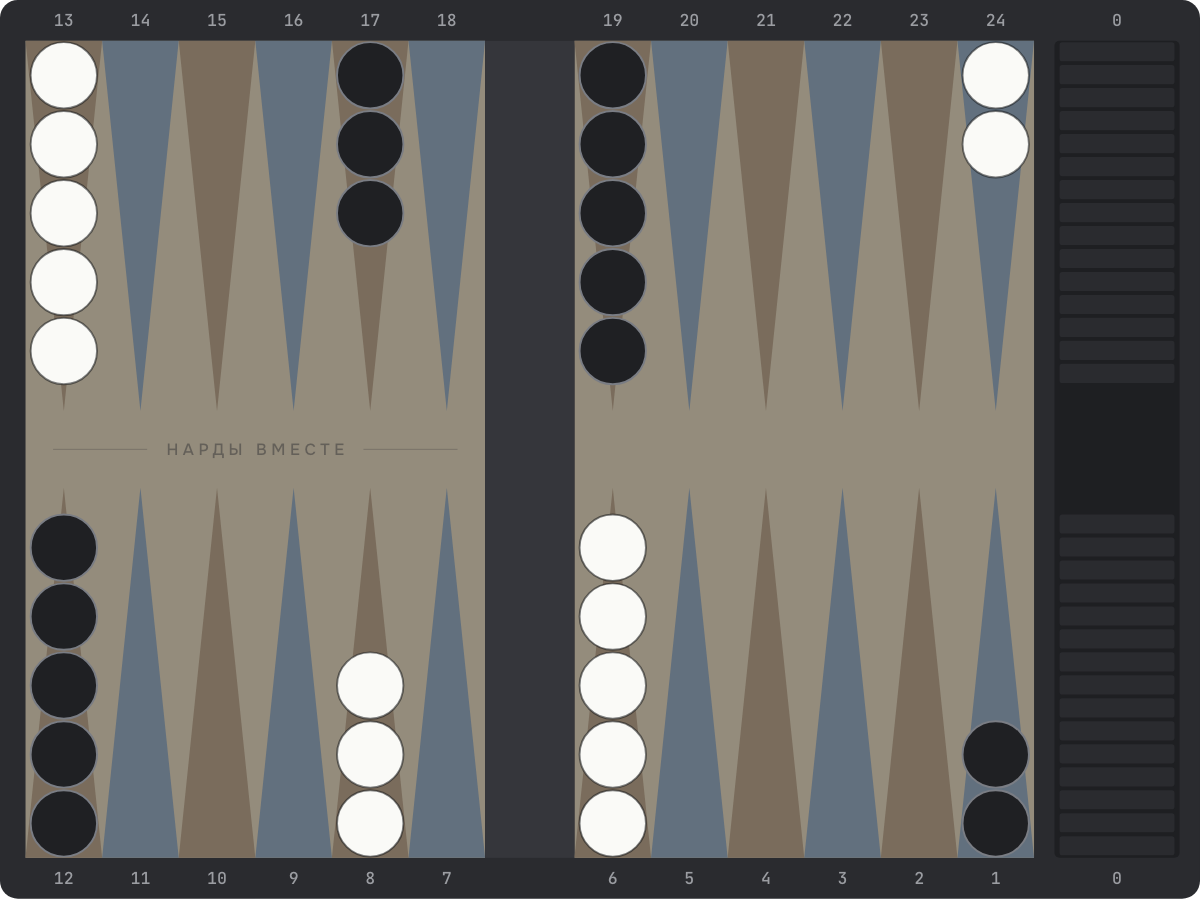
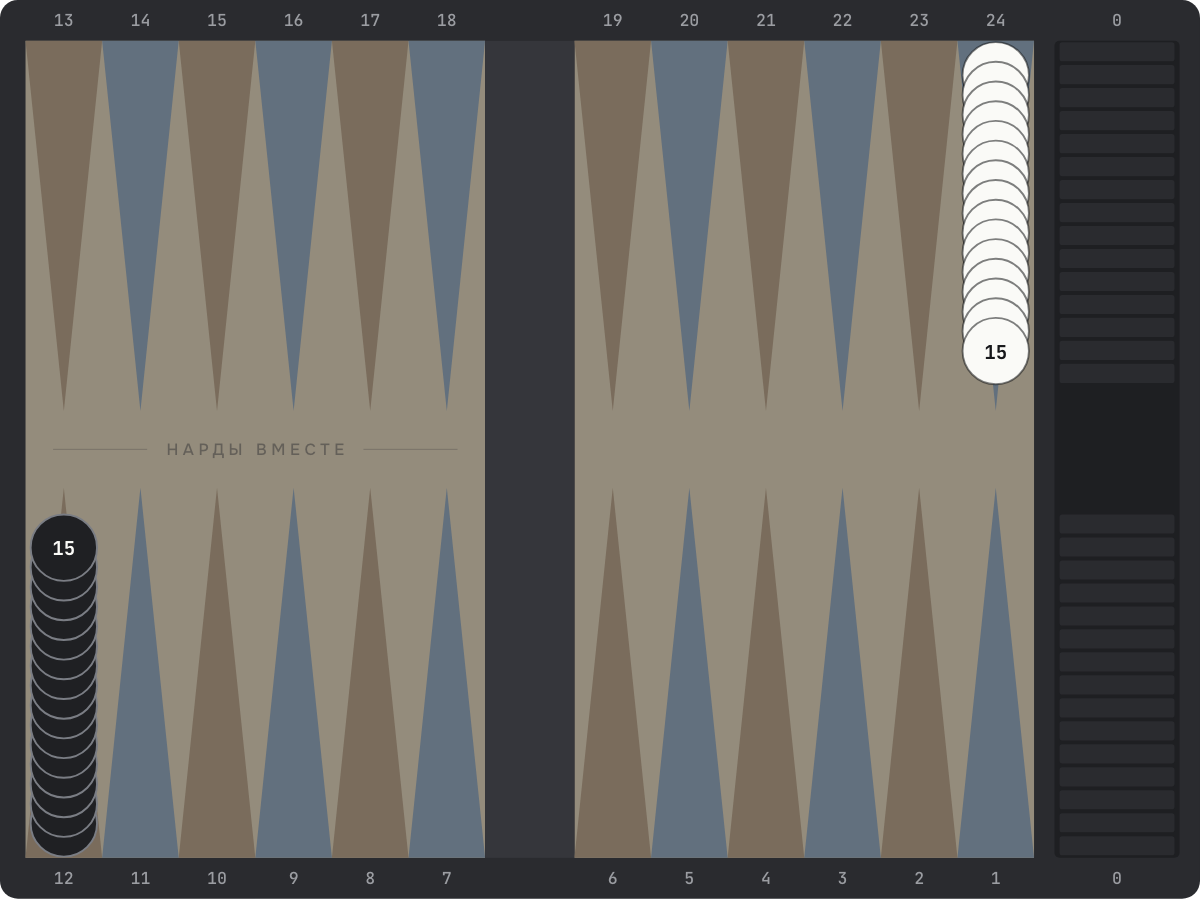
Because of the head, the first move in long nardy leaves almost no choice. We ran every move through the site's rules engine: in long nardy 20 of the 21 rolls give exactly one position after the first move, and only 3-3 gives two. In backgammon the first move is played with two different numbers, and each of those 15 rolls has from 7 to 18 different end positions. The full rules are on the backgammon rules and long nardy rules pages.
How long a game of nardy is compared with backgammon
We played 500 games of Hard Bot against itself in each game on the site's engine, without the cube. These are bot games, not human ones, but they show the order of the numbers.
| Per 500 games | Backgammon | Long nardy |
|---|---|---|
| Turns per game, both players, median | 51 | 92 |
| Checkers hit per game, average | 4.2 | 0 |
| Games with at least one hit | 96% | 0% |
| Turns with no legal move per game, average | 3.5 | 2.15 |
| Single game | 77.6% | 78.2% |
| Gammon / mars | 17.0% | 21.8% |
| Backgammon (koks) | 5.4% | not in the rules |
A game of long nardy is almost twice as long: 92 turns against 51. The checkers start on the head and travel 360 pips, not 167. In backgammon someone is hit in almost every game, four times on average, and a hit checker starts its journey again. In long nardy nothing can be hit. About one game in five ends in a gammon, mars or backgammon in both games.
Gammon and backgammon, mars and koks: the scoring words
In English, gammon and backgammon are also the names of wins. A gammon is a win when the loser has borne off no checkers: in nardy it is a mars, 2 points. A backgammon as a result is the same, but the loser also has a checker on the bar or in your home: in nardy it is a koks, 3 points. Long nardy has no koks.
So «won a backgammon» can mean a game of backgammon won, or a win by backgammon. The positions for each result are on the gammon and backgammon page.
Nardy terms in English
Nardy players have their own words, and some show up in English texts and in the site's long nardy games. Here is what they mean.
| Nardy word | In backgammon English | What it means |
|---|---|---|
| head (golova) | no equivalent | the point where all 15 checkers start in long nardy |
| oin | single game | an ordinary win, 1 point |
| mars | gammon | a win when the loser has borne off no checkers, 2 points |
| koks | backgammon | a mars with a loser's checker on the bar or in your home, 3 points; only in short backgammon |
| zabor | prime | several closed points in a row |
| short nardy | backgammon | the game with hitting and the doubling cube |
| long nardy | long backgammon, Russian backgammon | the game with the head and no hitting |
Where to play nardy and backgammon online
On this site you can play long nardy online and backgammon online: against the computer, with a friend by link or with real players, no sign-up needed. If you are new to long nardy, how to play long nardy walks through a first game move by move. A short summary of both games is on the rules page, and the button below starts a game.