How to play long nardy for beginners
To play long nardy, two players each put all 15 checkers on one point, the head, on a backgammon board. They take turns rolling two dice and moving checkers forward by the numbers, the same way round the board, with no hitting. You bring all 15 checkers home and bear them off. The first to bear off every checker wins.
How to play long nardy step by step
- Set up the board: all 15 white checkers on the 24-point, all 15 black checkers on the 12-point.
- Each player rolls one die. The higher number goes first and rolls both dice.
- Move forward by each die. You must play both dice if you can. Doubles are played four times.
- Only one checker may leave the head per turn. The exception is 6-6, 4-4 or 3-3 on your first turn: then two may leave.
- You cannot land on a point with an opposing checker. You cannot build six points in a row unless an opposing checker is already past them.
- When all 15 checkers are in your home, bear them off. The first to finish wins 1 point, or 2 points (mars) if the opponent has borne off none.
Each step is explained below, with a first game shown move by move.
What is long backgammon, and how is it different from backgammon
Long nardy (also called narde or nardi, and sometimes long backgammon) and short backgammon are two different games played on the same board. The dice and the goal are the same; almost everything else differs.
| Long nardy | Short backgammon | |
|---|---|---|
| Where the checkers start | All 15 on the head | Spread over four points |
| Hitting | No | Yes, a lone checker |
| Doubling cube | No | Yes |
| Points for a game | 1, mars 2 | 1, gammon 2, backgammon 3 |
If you don't know where to start, start with long nardy: there is no hitting and no bringing checkers back from the bar, so there are fewer rules for a first game. All the rules in order are on the long nardy rules and backgammon rules pages; every difference between the two games, with the length of a game in numbers, is on the nardy vs backgammon page.
Long nardy setup: how to set up the board and which way to move
In long nardy all 15 white checkers stand on the 24-point and all 15 black checkers on the 12-point. That starting point is called the head. The points on the diagrams are numbered from White's side. White moves from the 24-point down to the 1-point, and White's home is points 1 to 6. Black moves from the 12-point down to the 1-point, then from the 24-point to the 13-point, and Black's home is points 13 to 18. Both players move the same way round the board, counterclockwise.
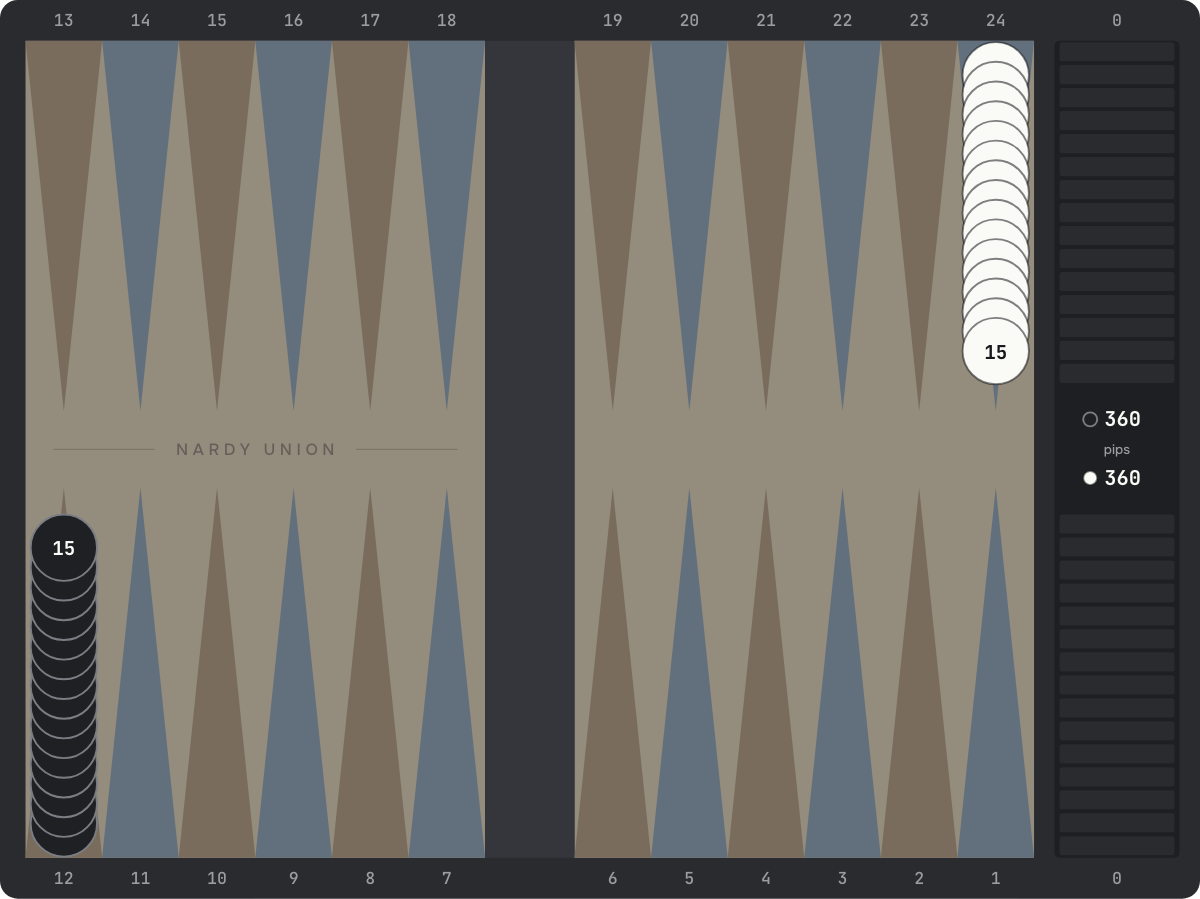
In short backgammon the checkers are set up differently, 2, 5, 3 and 5 checkers on four points, and the players move towards each other. You don't need to memorise either setup: in a game against the computer the site places the checkers for you.
Who goes first
Each player rolls one die, and the higher number goes first. In short backgammon that player plays those two numbers; in long nardy they roll both dice again. If the numbers are equal, both roll again. After that the players take turns, each rolling both dice.
How checkers move: a first game, move by move
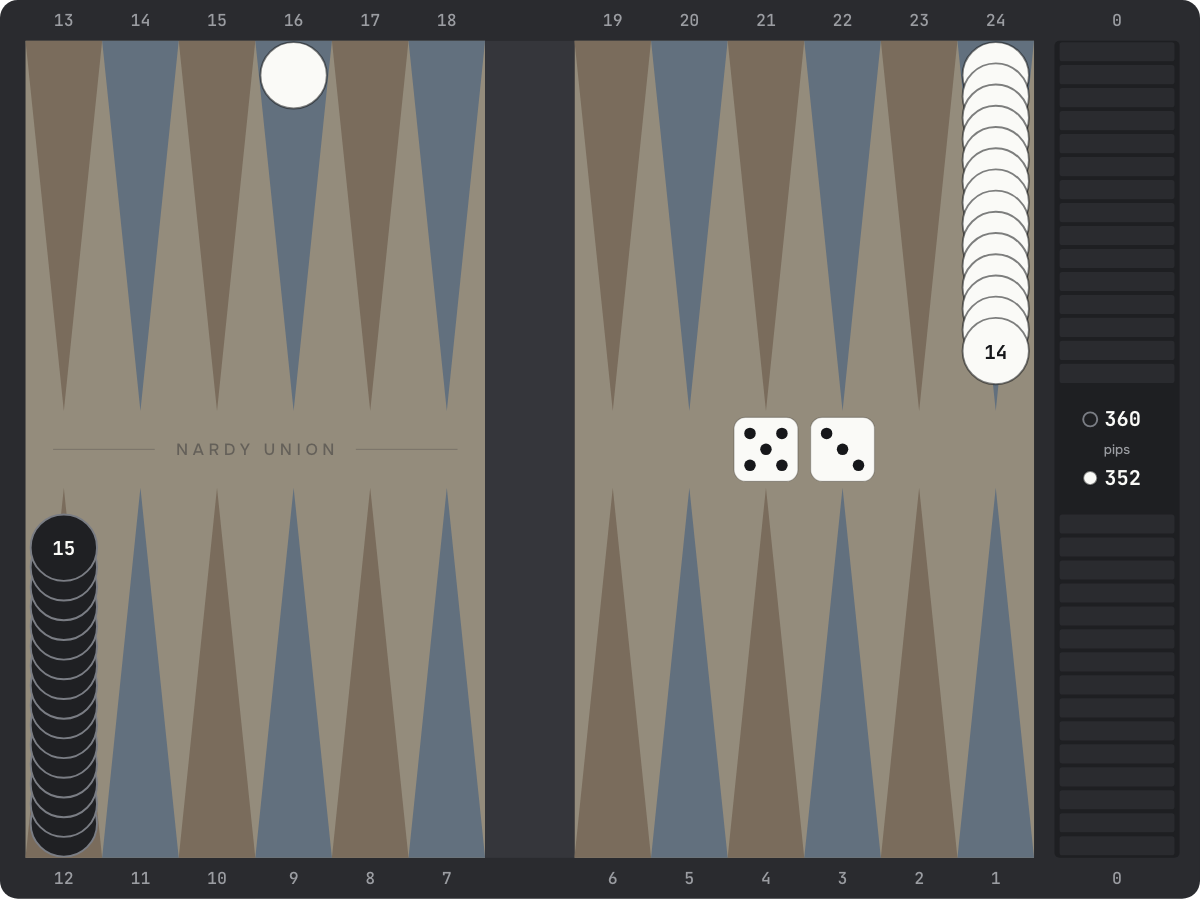
Each die is a separate move forward. If you roll 5 and 3, you can move one checker 5 and then 3, or two checkers. If both dice can be played, you must play both. Here are the first three moves of a long nardy game. The moves were checked by our rules engine: they are legal moves, not advice.
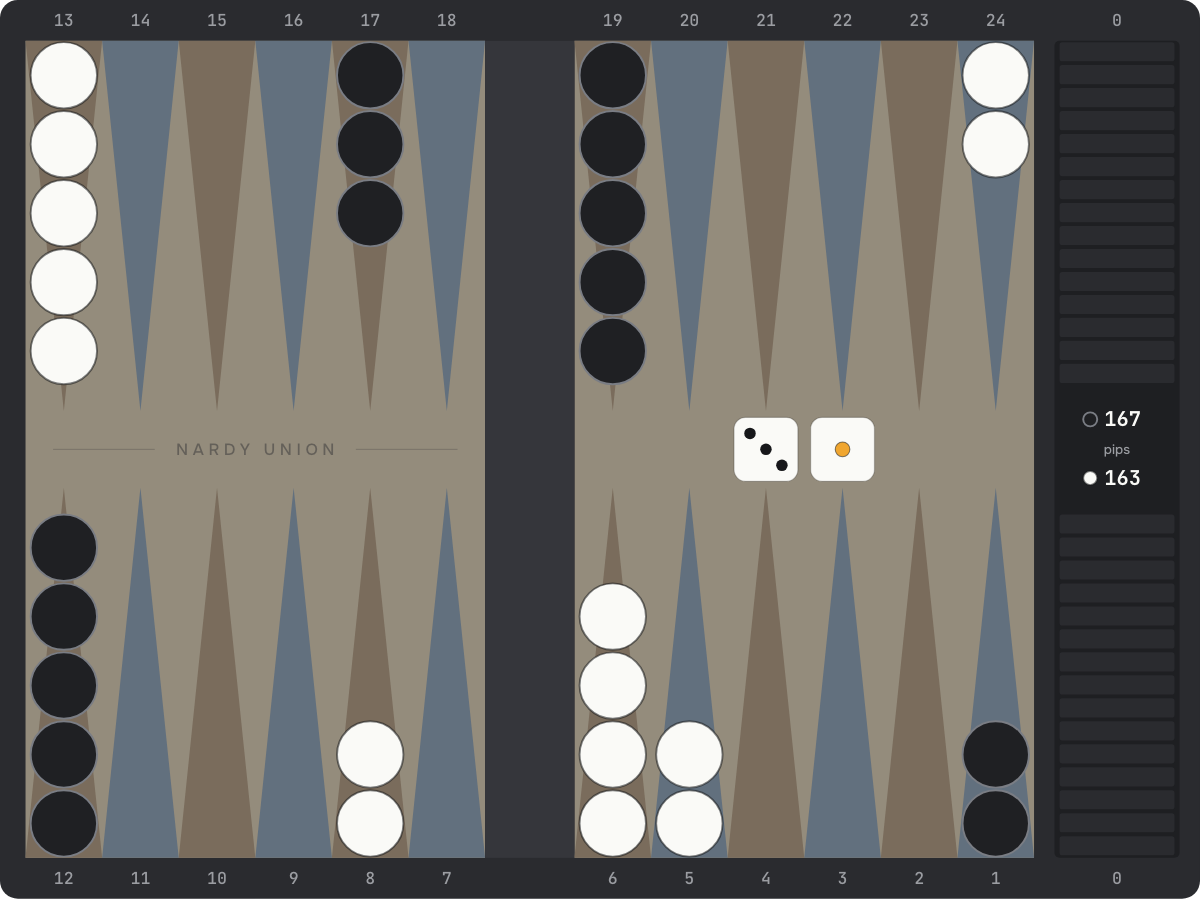
Move 1. White rolls 5-3. Only one checker may leave the head per turn, so one checker plays both dice: 24/19/16, from the 24-point to the 16-point.
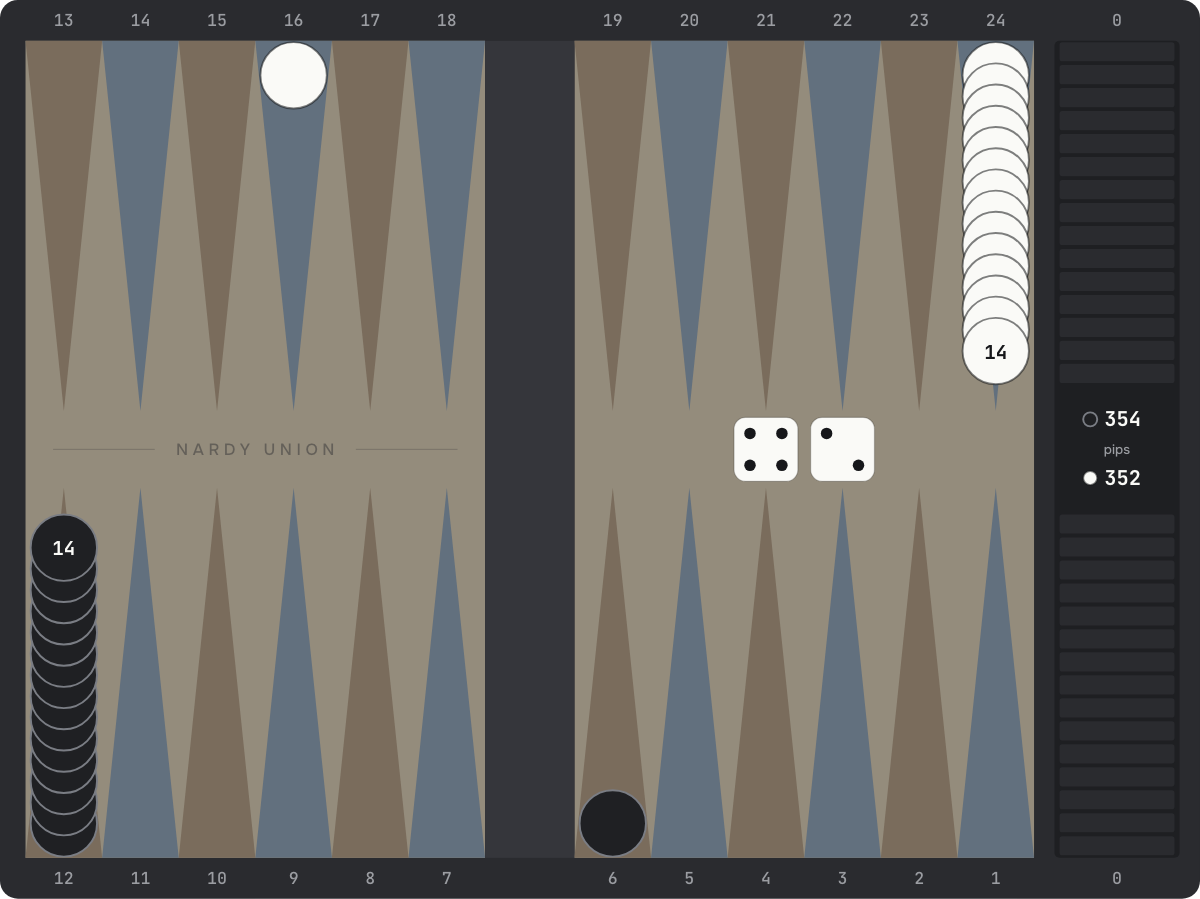
Move 2. Black rolls 4-2. Black also plays one checker from the head: from the 12-point to the 6-point, in White's numbering. The checker is now in White's home. It cannot be hit: there is no hitting in long nardy, and a point with an opposing checker on it is simply taken.
Move 3. White rolls 6-1. Now another checker may leave the head: 24/18. The 1 moves the first checker on: 16/15. Only one checker leaves the head per turn, so 6-1 cannot be played with two checkers from the head.
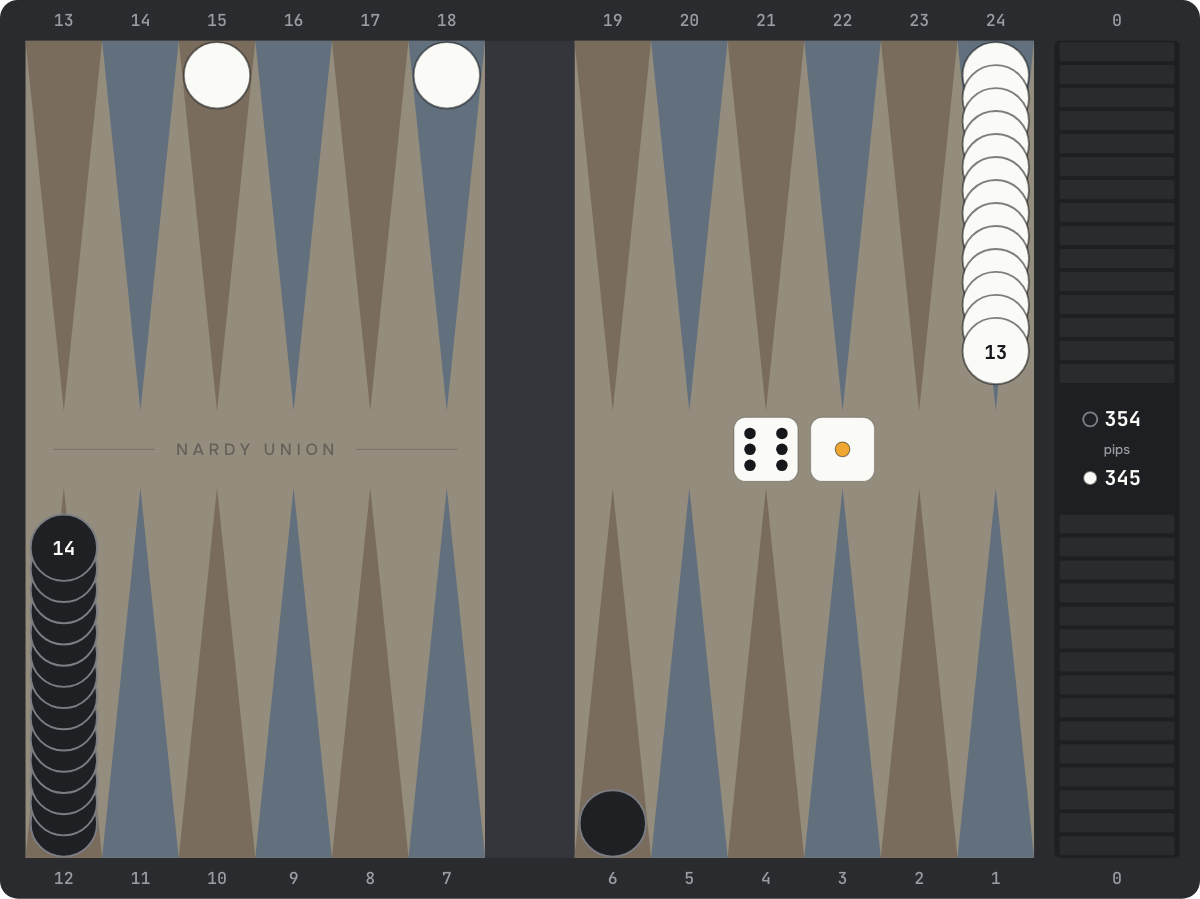
The game goes on the same way: roll, play the dice, pass the turn. The pip count, the total distance all your checkers still have to travel, shows who is ahead: after these three moves White has 345 and Black 354. The lower your count, the closer you are to the end.
What happens when you roll doubles
Doubles, the same number on both dice, are played four times. Roll 4-4 and you have four moves of four. Doubles come up in 6 rolls out of 36, on average once every six rolls. If you can't play all four moves, you play as many as you can. On your very first turn, 6-6, 4-4 and 3-3 let two checkers leave the head; the long nardy rules page shows every case.
What if you cannot move
In long nardy a point with an opposing checker on it is blocked: you cannot land on it, but you can jump over it. If neither die can be played, you lose your turn and your opponent rolls. If only one die can be played, you play it, and if you have a choice, the larger one. You may not pass up a move you are able to make.
How short backgammon begins
In short backgammon a lone checker can be hit: land on it and it goes to the bar, and its owner must bring it back into play first. Two checkers on a point close it. That is why players try to move their checkers in pairs. One opening move with 3-1: two checkers land on the 5-point.
Hitting, the bar and the doubling cube are covered in the backgammon rules.
Bearing off and who wins
Once all 15 checkers have reached your home, you start bearing them off: a die takes a checker off the point with that number. The first player to bear off every checker wins. If the opponent has borne off none, it is a mars, a win worth 2 points. In short backgammon this is called a gammon, and if the loser also has a checker on the bar or in your home, it is a backgammon, worth 3. The gammon and backgammon page explains the scoring with diagrams.
Common beginner mistakes
- Taking two checkers off the head in one turn. Only one may leave, and two only with certain doubles on your very first turn.
- Playing one die when both can be played. Both dice are compulsory.
- Trying to land on a point with an opposing checker in long nardy. It is taken, even with a single checker on it.
- Starting to bear off while one checker is still outside your home.
The board won't let you make an illegal move, so these mistakes cost you nothing in a game.
Where to practise
The fastest way to learn is to play. Start a game against the computer, no sign-up needed. To pick a game, see long nardy online and backgammon online. A short summary of both games is on the rules page. When you know the rules, the long nardy strategy page shows where real games are lost. You can start with the button below.