How to win at backgammon: eight tips and the numbers behind them
To win at backgammon, give your opponent few good rolls and yourself many: make points in your home board, don't leave a lone checker within six pips of an enemy checker, hit when your home board is strong, and race only when you are ahead in the pip count. Below are eight tips, each with the numbers behind it.
Point numbers are from White's side, as on the diagrams. White moves from the 24-point to the 1-point, and White's home board is points 1 to 6. The notation 8/5 means a checker moved from the 8-point to the 5-point. If the rules are still new to you, start with the backgammon rules.
Can you win at backgammon every time?
No. The dice decide a lot, and a strong move can still lose to a lucky roll. But the dice are the same for both players: over many games the difference comes from the moves. Backgammon is a game of luck and skill. A good player wins more often, not always, because they leave fewer shots, waste fewer rolls and know when the race favours them.
1. Make a point with your opening roll
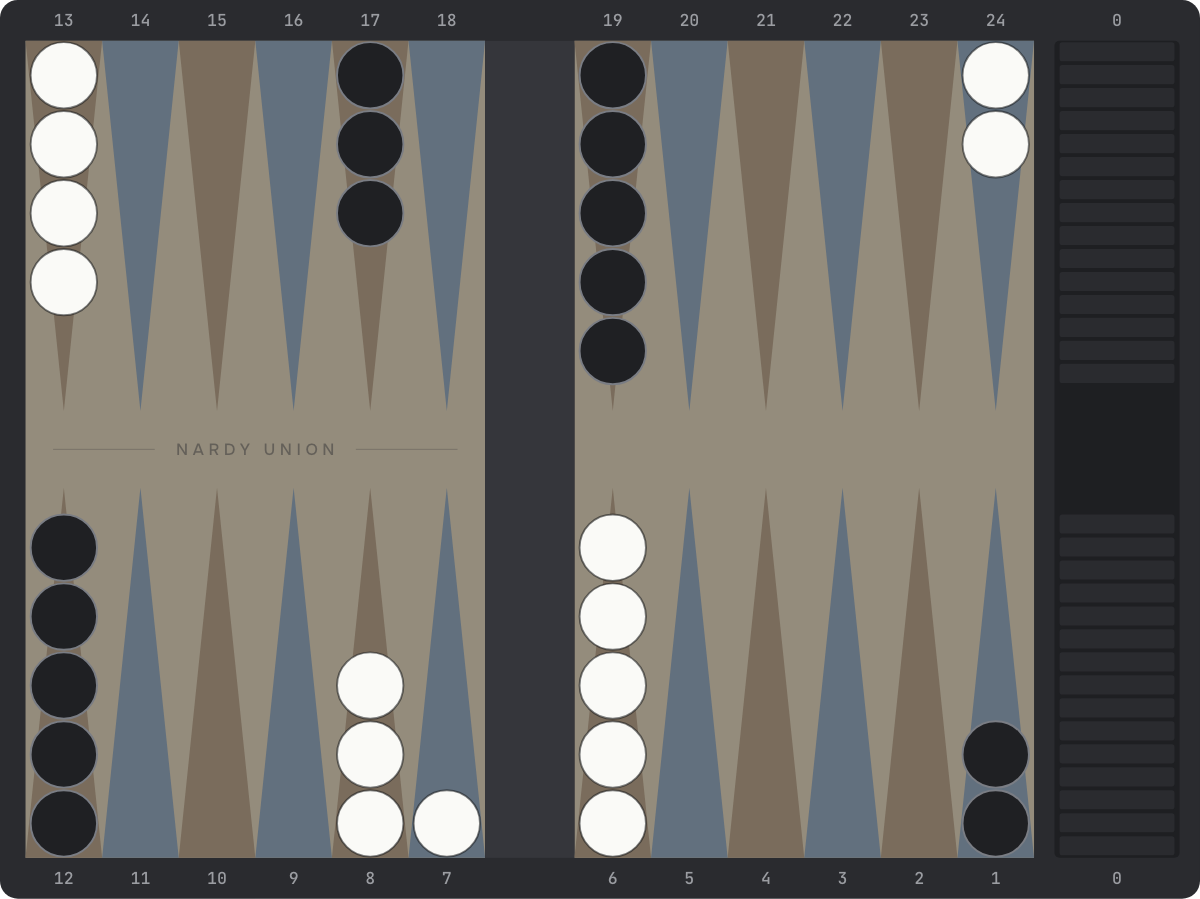
A point is closed when two of your checkers stand on it, and the opponent can't land there. The opening roll is never a double, since each player rolls one die. Of the 15 possible opening rolls, 5 make a new point at once:
| Opening roll | Move | Point made |
|---|---|---|
| 3-1 | 8/5 6/5 | 5-point |
| 4-2 | 8/4 6/4 | 4-point |
| 6-1 | 13/7 8/7 | 7-point (bar point) |
| 5-3 | 8/3 6/3 | 3-point |
| 6-4 | 8/2 6/2 | 2-point |
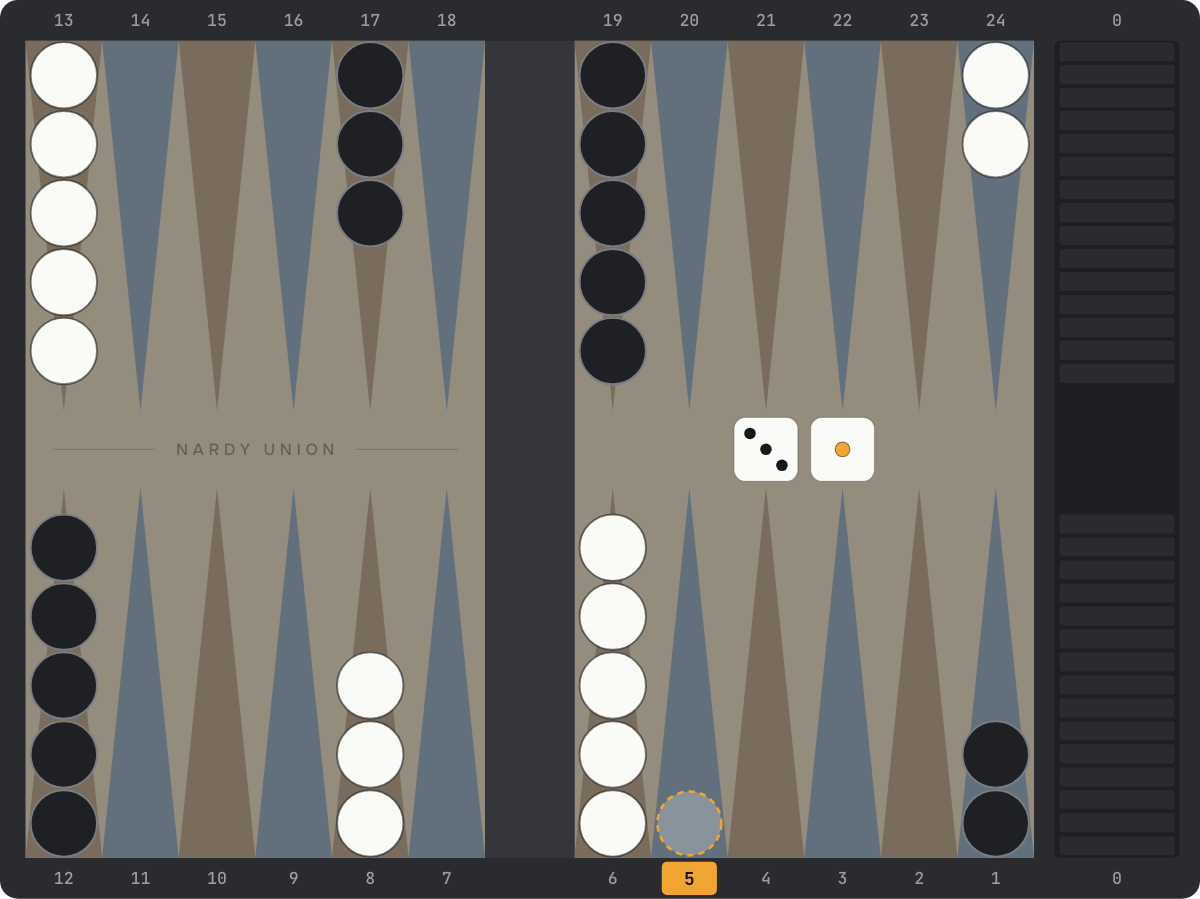
Our Hard Bot makes the point with each of these five rolls. With the other ten it brings checkers down from the 13-point or moves a back checker. With 6-5, for example, it plays 24/18 18/13: one back checker runs all the way to the 13-point. That is a bot's choice, not a solved answer.
2. Make your 5-point first
The 5-point is the most useful point in your home board. It blocks the opponent's back checkers, it is a landing spot for your checkers coming home, and it closes one of the six points where a hit checker must enter. Your 4-point and bar point (the 7-point) come next. Points deep in your home board, the 1-point and 2-point, block little early in the game.
3. Don't leave a blot within six pips
A blot is a lone checker. If the opponent lands on it, it goes to the bar and must start again. How many of the 36 rolls hit a blot depends on how far away the enemy checker is, if no closed points stand in between:
| Distance (pips) | Rolls that hit | About |
|---|---|---|
| 1 | 11 of 36 | 31% |
| 2 | 12 of 36 | 33% |
| 3 | 14 of 36 | 39% |
| 4 | 15 of 36 | 42% |
| 5 | 15 of 36 | 42% |
| 6 | 17 of 36 | 47% |
| 7 | 6 of 36 | 17% |
| 8 | 6 of 36 | 17% |
| 9 | 5 of 36 | 14% |
| 10 | 3 of 36 | 8% |
| 11 | 2 of 36 | 6% |
| 12 | 3 of 36 | 8% |
Six pips is the most dangerous distance: almost every second roll hits. From seven pips on, the chance drops sharply, because one die can no longer reach and only a sum of both dice or a double can. So if you must leave a blot, leave it seven or more pips from the enemy checkers. A closed point of yours in between lowers the odds further.
4. Build your home board before you hit
A hit checker has to enter in your home board before your opponent may move anything else. Every point you close there shuts one entry. The more points closed, the more often the whole turn is lost:
| Points closed in your home board | Rolls that let a hit checker enter | Rolls where the opponent's whole turn is lost |
|---|---|---|
| 1 | 35 of 36 | 1 of 36 |
| 2 | 32 of 36 | 4 of 36 |
| 3 | 27 of 36 | 9 of 36 |
| 4 | 20 of 36 | 16 of 36 |
| 5 | 11 of 36 | 25 of 36 |
| 6 | 0 of 36 | 36 of 36 |
That is why a hit is worth more when your home board is strong. Against one or two closed points the hit checker comes straight back in. Against four or five, your opponent may lose several turns in a row while you keep building.
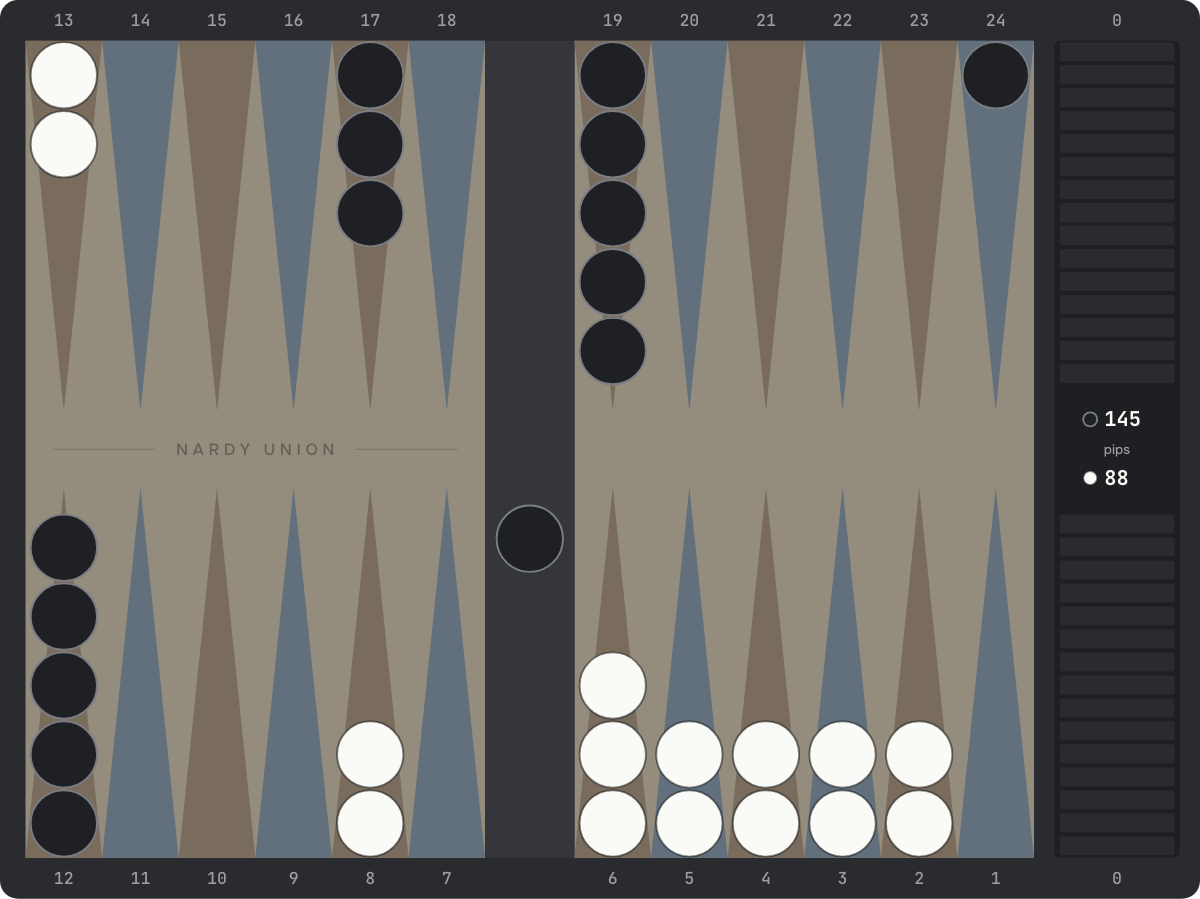
The reverse holds too. When your opponent's home board has three or four closed points, getting hit is expensive, so take more care not to leave blots.
5. Build a prime
A prime is several closed points in a row. A checker moves at most six pips with one die and must land on an open point after each die, so six closed points in a row cannot be passed at all. A checker trapped behind a full prime waits until you break it. Five or four in a row still stop most rolls. Points in a row are worth more than the same number of points spread around the board.
6. Don't stack checkers
Five or six checkers on one point hold one point. The same checkers spread over three points can make new points next turn. Keep spare checkers, builders, a few pips above the points you want to make, such as on the 8-point to the 11-point for your home board. A heavy stack also leaves you fewer useful moves later, when every number counts.
7. Count pips: race when ahead, hold when behind
Your pip count is the total distance your checkers still have to travel. Both players start at 167. One roll moves 8.17 pips on average (doubles count four times), so 8 pips is about one roll. Our board shows both pip counts during the game.
Once the checkers have passed each other and no hit is possible, the game is a race. If you are ahead, run: bring your back checkers home and avoid new contact. If you are behind and contact remains, don't run your back checkers too early. Hold a point in your opponent's home board, an anchor, and wait for the blot they may have to leave.
8. When you are losing, save the gammon
If your opponent bears off all 15 checkers before you bear off any, you lose a gammon, 2 points, or a backgammon, 3 points, if you still have a checker on the bar or in their home board. Once the game is lost, change the goal: bring every checker home and bear off at least one. Then you lose only 1 point. The details are on the gammon and backgammon page; how to bear off fast is in bearing off in backgammon.
The four backgammon game plans
Most games follow one of four plans. Which one fits depends on the pip count and on who has the stronger home board.
| Plan | When it fits | What you do |
|---|---|---|
| Racing | You are ahead in the pip count | Run your back checkers and avoid contact |
| Priming | Opponent's back checkers are still behind your points | Close points in a row in front of them |
| Blitzing | Opponent has blots in your home board, you have builders nearby | Hit and close home points fast |
| Holding | You are behind in the race | Keep an anchor in their home board and wait for a shot |
The doubling cube adds one more decision: when to raise the stakes and when to take. That is on the backgammon doubling cube page.
Backgammon strategy tips: short list
| Situation | What to do |
|---|---|
| Opening 3-1, 4-2, 6-1, 5-3 or 6-4 | Make the point |
| You can make your 5-point | Make it |
| You must leave a blot | Seven or more pips from enemy checkers |
| Opponent leaves a blot | Hit, especially when your home board is strong |
| Opponent is on the bar | Close more home points |
| Your checker is on the bar | Enter it first: nothing else may move |
| Checkers piling on one point | Spread them as builders |
| No more contact | Count pips; if ahead, run |
| The game is lost | Bear off one checker to avoid a gammon |
Where to practise
A tip is easy to read and hard to see in a game. Start with backgammon against the computer: there are Easy, Medium and Hard bots, and the board won't allow an illegal move. After a game, open its analysis: it compares your moves with the options it finds, and your own mistakes stick better than anyone else's. When you are ready, play a friend or an opponent online in backgammon online. Both games' rules in brief are on the rules page.