Backgammon terms and nardy words: a player's glossary
Backgammon terms are the words players use for the board, the dice, the moves and the result: point, bar, pip, blot, prime, anchor, gammon. Long nardy adds its own: head, kush, mars, koks. Each is defined in a few sentences, with a link to its rule. Every term has an address: add #pip or #mars to this page's.
What does the word backgammon mean, and what is nardy?
Backgammon is a game for two on a board of 24 points, with 15 checkers each and two dice. In English the same word also names its biggest win, worth 3 points. Nardy is the Russian name of the family: long nardy is the game played most in Russia and the Caucasus, short nardy is backgammon itself. Every rule that differs is in one table on the nardy vs backgammon page.
Long nardy. All 15 checkers start on one point, the head, both players move the same way, and nothing is ever hit. Also called narde, nardi or long backgammon. The full rules: long nardy rules.
Short backgammon. The checkers start on four points, the players move towards each other, and a lone checker can be hit. The game the rest of the world calls backgammon: backgammon rules.
Match. Several games until one player reaches an agreed number of points, 1, 3, 5 or 7 on this site. Each game brings its winner 1, 2 or 3 points.
Backgammon board terms: what is the bar, the home board and a pip?
The board is the same for both games. Points are numbered 1 to 24 from each player's side: your 1-point is the last on your path. The diagrams use White's numbers.
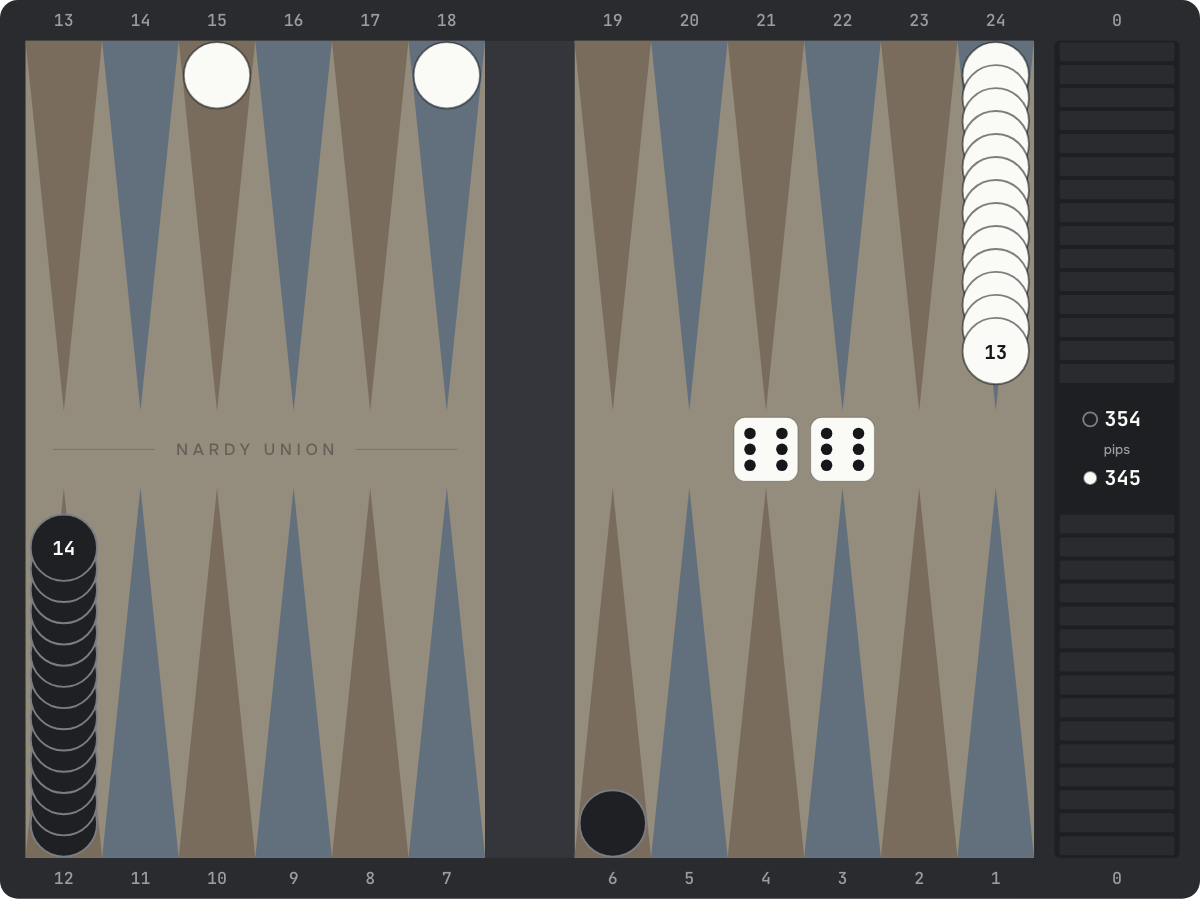
Checker. One of the 15 round pieces of your colour, also called stones or men. What is in a set and where the checkers start is on the how many pieces in backgammon page.
Point. One of the 24 long triangles on the board. A point can hold any number of your checkers. Six points in a row make a quarter, or table; the board has four.
Home board (home). The last quarter on your path, points 1 to 6 for White. You may bear off only when all 15 of your checkers are in it.
Bar. The ridge in the middle of the board between the 6-point and the 7-point. In short backgammon a hit checker is placed on it and must re-enter before any other checker moves. In long nardy nothing is hit, so the bar only divides the board. The bar point is the 7-point, the first point outside your home board.
Head. The point where all 15 of your checkers start in long nardy: the 24-point for White, the 12-point for Black. Only one checker may leave the head per turn, except on your first turn with 6-6, 4-4 or 3-3, when two may leave. Short backgammon has no head.
Pip. One spot on a die: a roll of 5-3 is 8 pips. The pip count is the total distance all your checkers still have to travel to be borne off: 167 at the start of short backgammon, 360 at the start of long nardy. An average roll moves 8.17 pips.
Dice terms: what is a double, and what does kush mean?
Roll. The two numbers on the dice, such as 6-5. There are 36 ways two dice can fall. Each die is played as a separate move.
Double (doublet). Both dice show the same number: 3-3, 5-5, 6-6. A double is played four times, so 5-5 is four moves of five. Six of the 36 rolls are doubles, one roll in six on average.
Kush. The nardy word for a double. In long nardy a kush on your first turn is a special case: with 6-6, 4-4 or 3-3 two checkers may leave the head instead of one.
Du-shesh, shesh-besh. Nardy players name the numbers on the dice with their own words, yek 1, du 2, se 3, char 4, pendj or besh 5, shesh 6, and a roll by both numbers, the higher first. Du-shesh is 6-6, the longest roll: four moves of six, 24 pips. Shesh-besh is 6-5, and often the game itself. The site shows the dice as numbers.
What is a blot, a hit, a prime and an anchor?
Hitting exists only in short backgammon. Long nardy has no hitting, which makes blocking the whole game there.
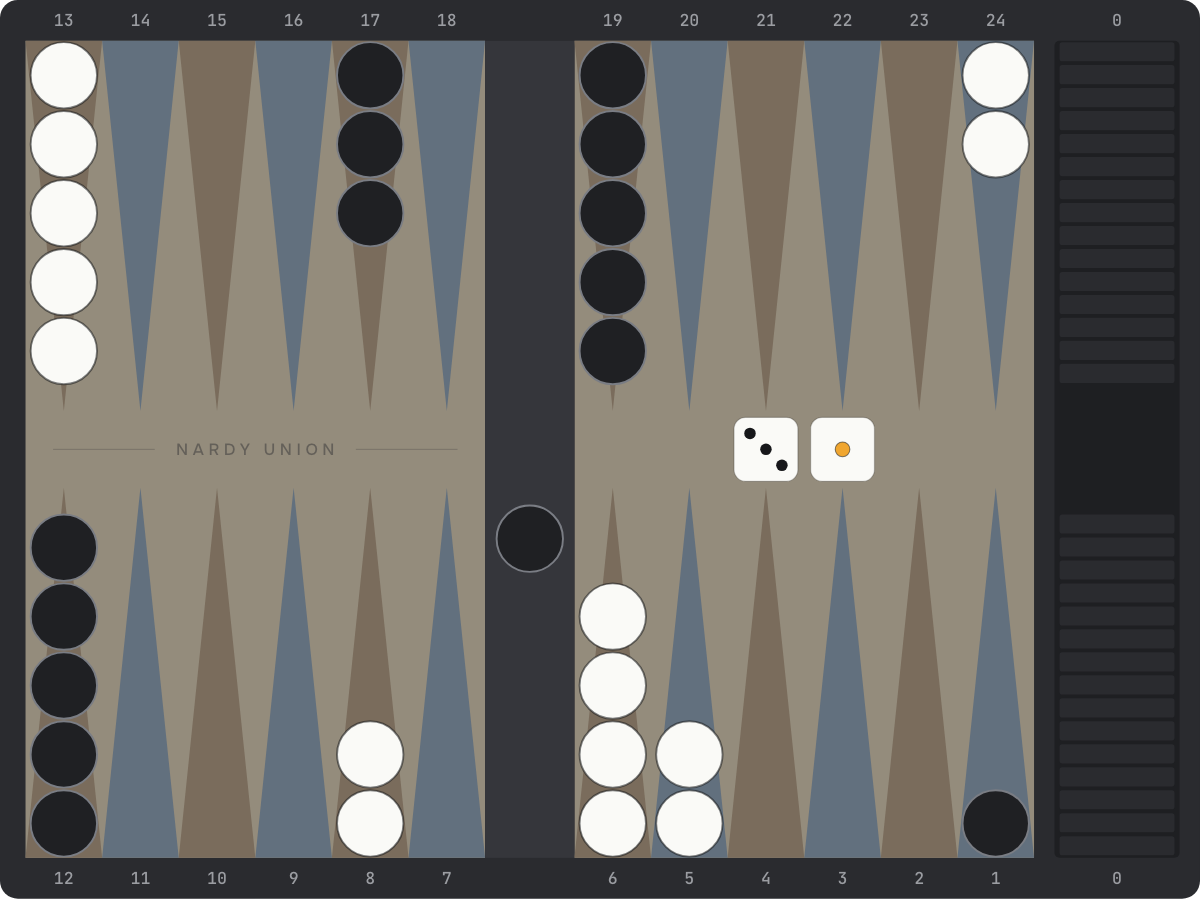
Closed point (made point). A point you cannot land on. In long nardy one opposing checker closes a point; in short backgammon it takes two or more.
Prime (block). Several closed points in a row on your opponent's path: a five-prime, a six-prime. A six-prime cannot be passed at all, because a single die moves at most six. In long nardy you may not build six in a row until an opposing checker is already in front of the block; in short backgammon you always may. More on the how to win at backgammon page.
Blot. A single checker on a point in short backgammon. It can be hit. Two checkers on a point are safe.
Hit. Landing on a blot. The hit checker goes to the bar, and the move is written with a star: 13/8*.
Enter. Bringing a checker from the bar back onto the board in your opponent's home board. The die picks the point: a 1 enters on your 24-point, a 6 on your 19-point, next to the bar. While a checker is on the bar, no other checker may move.
Anchor. A point in your opponent's home board that you hold with two or more checkers. Checkers on an anchor cannot be hit, and it gives you a safe landing when you enter from the bar.
Bear off. Take a checker off the board when all 15 are home. A die bears off a checker from the point of its own number; a higher die bears off the farthest checker if no checker stands on a higher point. Every case is on the bearing off in backgammon page.
Race. The end of a game once the two sides have passed each other and can no longer block or hit. The lower pip count wins.
Backgammon winning terms: single game, gammon, backgammon, mars and koks
The winner is the first to bear off all 15 checkers. How much the win is worth depends on how far the loser got.
| Result | When | Short backgammon | Long nardy |
|---|---|---|---|
| Single game (oin) | The loser has borne off at least one checker | 1 point | 1 point |
| Gammon | The loser has borne off no checkers | 2 points | mars, 2 points |
| Mars | The nardy name of a gammon | 2 points | 2 points |
| Backgammon (koks) | The loser has borne off none and has a checker on the bar or in the winner's home board | 3 points | no such result |
| Koks | The nardy name of a backgammon | 3 points | no such result |
The positions for each result, with pictures, are on the gammon and backgammon page. A home mars, a mars where the loser has not even brought all checkers home, has no price of its own on this site.
Doubling cube. A die marked 2, 4, 8, 16, 32 and 64 in short backgammon. A player offers to double the stake; the opponent takes, and the game goes on for twice as much, or passes and loses the current stake. The result is multiplied by the cube: a gammon with the cube on 4 is 8 points. Long nardy has no cube. When to double and when to take is on the backgammon doubling cube page.
Crawford game. In a match, the game right after one player first comes within one point of the match length. Nobody may double in it; the cube returns in the game after.
A summary of both games is on the rules page.
Where you meet these words in a game
Start a game against the computer with the button below: the board shows which points are closed, counts the pips and names the result. If you are new to long nardy, how to play long nardy walks through a first game move by move. Or play long nardy online and backgammon online with a friend by link.